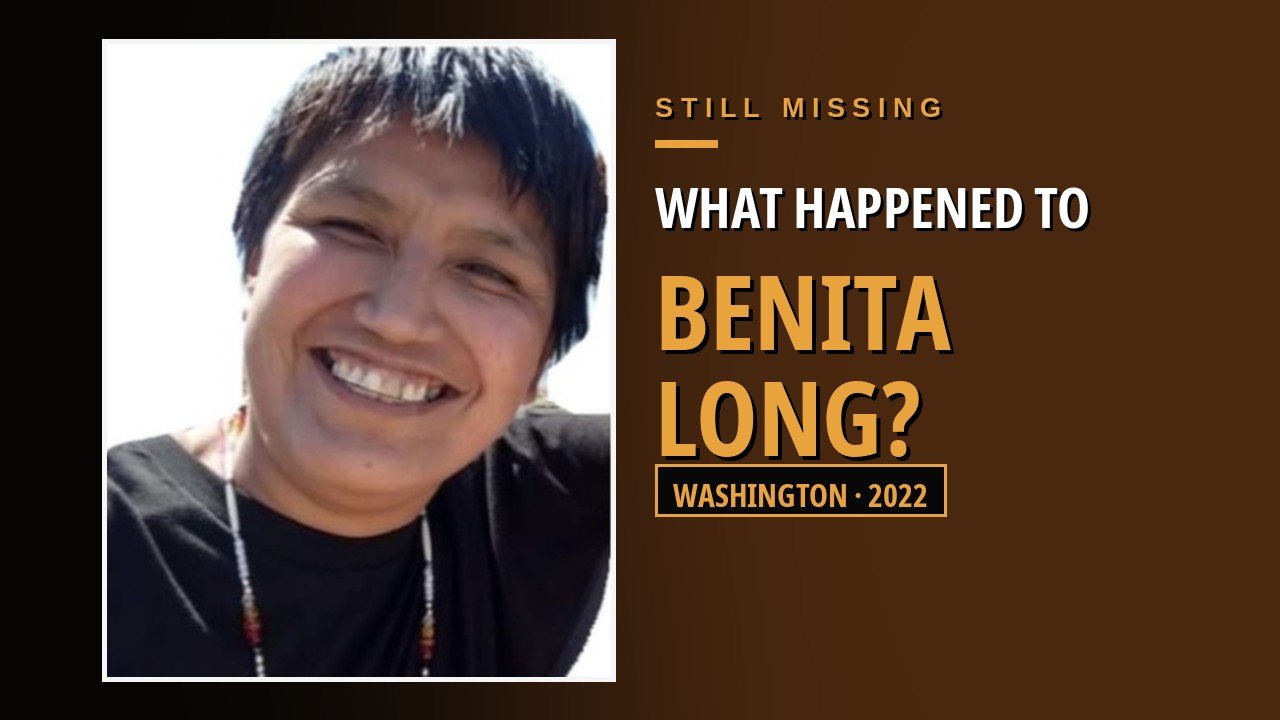
Key facts
- Name: Benita Long
- Born: ~1982
- Age at disappearance: 40
- Last seen: March 26, 2022 — dropped off at the El Corral Motel, Toppenish, Washington
- Location: Toppenish, near the Yakama Indian Reservation, Washington
- Last seen wearing: Gray sweatpants and a black hoodie
- Height / build: Published descriptions vary (~5’3″–5’4″, brown eyes); no law-enforcement poster with a physical description was located — treat specifics as unverified
- Status: Still missing — Yakama Nation PD case 22-004079; not listed in NamUs (per NPR’s 2025 investigation)
- Investigating agency: Yakama Nation Police Department
The crisis with a name
Benita Long was last seen on March 26, 2022, wearing gray sweatpants and a black hoodie, getting dropped off at the El Corral Motel in Toppenish, Washington — not far from the Yakama Nation reservation. She was 40. She has not been seen since.
Benita was a Yakama woman, an adult who, according to her family, struggled with addiction and occasional homelessness and relied on the monthly payments she received as a Yakama Nation member to keep afloat. In the early spring of 2022, her family realized no one had heard from her in weeks — and that those monthly payments had sat in her account, untouched, for two months. That was when they reported her missing to the Yakama Nation police.
Her cousin Loni Long, who grew up close to Benita, became the family’s voice. “She showed me how to stick up for myself, kind of be strong,” Loni told NPR in 2025.
Benita Long is one of the faces of the crisis of missing and murdered Indigenous women: cases that get a fraction of the coverage, a fraction of the resources, and a fraction of the urgency. The details of her case — where exactly she went after the motel, who she was with — have been reported thinly, which is itself part of the story.
Who Benita was
Benita Long was 40, living on or near the Yakama Reservation in south-central Washington. The public record of her life is sparse — not because her life was small, but because the systems that document disappearances have historically documented Indigenous women’s disappearances poorly, late, or not at all.
What is known: she was last seen on March 26, 2022. Her family reported her missing weeks later, in the spring of 2022. She has not been seen since. Her family wants her home.
The investigation
The Yakama Nation Police Department carries the case (22-004079). What the investigation has produced — searches, interviews, leads — has not been widely publicized. The department did not respond to multiple inquiries from NPR in 2025. No suspect has been named. No arrest has been made. No trace of Benita has been found.
In March 2025, NPR’s investigation into missing-persons databases revealed something her family hadn’t known: Benita’s case had never been entered into NamUs, the federal National Missing and Unidentified Persons System — even though Washington is one of the states where reporting to NamUs is effectively expected. NPR found that as of August 2024, 65% of Washington’s 2,349 missing people weren’t listed in NamUs. Benita was one of them. “We need the help. She needs the help,” her cousin Loni said.
Her case sits within a national emergency that has finally begun to get official recognition: Washington state has one of the highest rates of missing and murdered Indigenous women in the country — Indigenous women there go missing at about four times the rate of white women, according to the Urban Indian Health Institute — and the Yakama Reservation has been one of its epicenters. In recent years, Washington’s Missing and Murdered Indigenous Women and People task force, federal legislation, and tribal advocacy have pushed for better data, better coordination, and faster responses. Benita Long’s case is one of the ones they’re talking about.
Theories: what might have happened
Foul play. The investigative posture and the context — an Indigenous woman in a vulnerable situation vanishing near reservation land, where jurisdictional gaps have historically hampered investigations — point toward homicide. Supports it: more than four years of total silence, untouched tribal payments, no voluntary-departure indicators. Unresolved: no suspect named, no body found, few public details.
The jurisdictional and data gap. Not a theory of what happened to Benita, but of why it remains unsolved: crimes on and near reservation land fall into a maze of tribal, state, and federal jurisdiction that has historically meant delayed responses and dropped threads — and her case wasn’t even entered into the federal missing-persons database until NPR flagged it in 2025. Washington’s MMIWP task force was created to fix exactly this. Whether it fixes it in time for Benita Long remains an open question.
Have information?
Contact the Yakama Nation Police Department at (509) 865-2933 (case 22-004079). In an emergency, dial 911.
Timeline
- ~1982 — Benita Long is born.
- March 26, 2022 — Last seen in gray sweatpants and a black hoodie, dropped off at the El Corral Motel, Toppenish, WA; vanishes.
- Spring 2022 — Family reports her missing to Yakama Nation PD (case 22-004079) after weeks without contact.
- March 2025 — NPR investigation reveals her case was never entered into NamUs.
- 2022–2026 — Case remains open; no trace found; cited in MMIW advocacy and Washington’s MMIWP task-force work.
- Today — Still missing.
FAQ
Is Benita Long still missing?
Yes. As of October 2026, Benita Long has been missing for more than four years. No trace of her has ever been found.
Was Benita Long ever found?
No. She has never been located.
What is case 22-004079?
The Yakama Nation Police Department’s case number for Benita Long’s disappearance. Anyone with information should reference it when calling (509) 865-2933.
How old would Benita Long be today?
Benita was 40 in early 2022 — she would be 44 now.
Why is Benita Long’s case connected to the MMIW crisis?
Benita is an Indigenous woman who vanished near reservation land — the exact profile at the center of the missing and murdered Indigenous women crisis. Washington has one of the highest rates of MMIW cases in the country (Indigenous women go missing there at about four times the rate of white women, per the Urban Indian Health Institute), and advocates cite her case in pushing for better data and jurisdictional coordination.
Was Benita Long’s case in the NamUs database?
No — NPR’s March 2025 investigation found it had never been entered, even though Washington effectively expects missing-person cases to be reported there. Her family learned this from NPR’s reporting.
How can I help?
Share this case file. Anyone with information should contact the Yakama Nation Police Department at (509) 865-2933, referencing case 22-004079.
Corrections (October 2026 verification pass)
- Last seen: “January 17, 2022” → March 26, 2022. Per NPR (March 2025): last seen in gray sweatpants and a black hoodie, dropped off at the El Corral Motel, Toppenish, WA. The January date was unsupported in any published source.
- Age: “33 (born ~1988)” → 40 (born ~1982). NPR reports “Benita, then age 40” in early 2022. Meta description, FAQ, and timeline corrected accordingly.
- Physical description corrected: “5’4″, ~140 lbs, long dark hair, brown eyes” could not be verified in any published source and conflicts with an advocacy listing (5’3″, short brown hair, chin scar, tattoos, leg burn scar). Replaced with the NPR-verified clothing detail; remaining physical specifics flagged as unverified.
- “Reported missing January 2022” → spring 2022: family reported her missing weeks after last contact, when two months of untouched tribal payments made the silence undeniable (NPR).
- FBI removed as investigating agency — FBI involvement in this case is unverified in published sources (the Yakama Nation police did not respond to NPR’s inquiries).
- Added verified facts: cousin Loni Long as family voice; addiction and occasional homelessness (per family via NPR); monthly Yakama Nation payments untouched for two months; the case was never entered into NamUs (NPR, March 2025) — and “NamUs” removed from the reference list accordingly, as was NCMEC (children’s agency, unverifiable for this adult case).
- “Advocates have used her name — with her family’s permission” reworded — the permission detail was unverifiable.
Sources
- Official / law enforcement: Yakama Nation Police Department (509-865-2933; case 22-004079); Washington State MMIWP Task Force; Urban Indian Health Institute (missing-rate data via NPR).
- News: NPR, “Benita Long disappeared. So why wasn’t she added to this missing person database?” (March 10, 2025); Yakima Herald-Republic; KUOW.
Found an error? Tell us via the About page and we will fix it promptly and note the change here. Last verified October 2026.