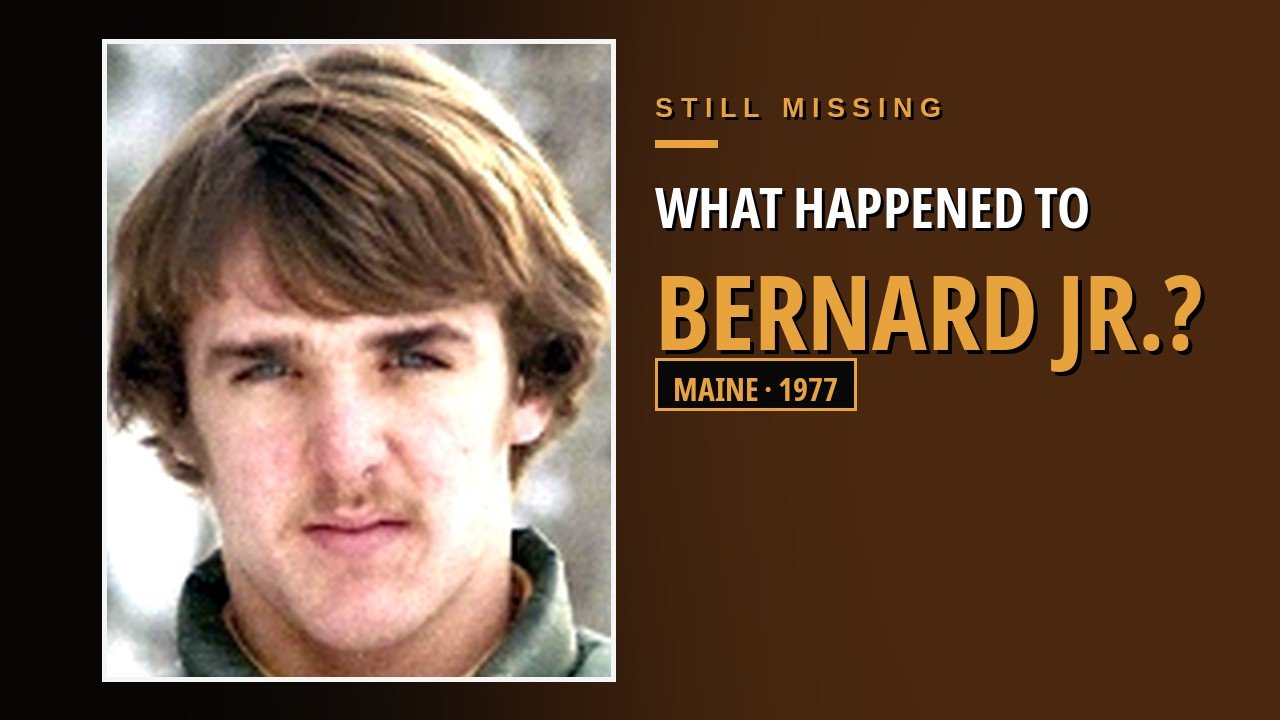
Key facts
- Name: Bernard “Bunny” Ross Jr.
- Age at disappearance: 18
- Last seen: May 12, 1977, after walking out of the family home in Fort Kent, Maine
- Location: Fort Kent, Aroostook County, Maine; trail went cold on a remote dirt road near the Ashland–Portage town line
- Description: Last seen wearing a green down vest, a gold chamois shirt, and brown corduroy pants; scar on his abdomen, chicken-pox marks on his nose
- Status: Still missing; cold case, reignited by a 2016 anonymous letter
- Investigating agency: Maine State Police, Major Crimes Unit — (207) 973-3750
The walk out the door
On May 12, 1977, eighteen-year-old Bernard Ross Jr. — called “Bunny” by his family — walked out of his family’s home in Fort Kent, Maine, and never came back.
There had been trouble. Ross had been in a distressed period, and — the Charley Project reports, on the very day he vanished — he stole a truck from his aunt’s home in Presque Isle. It was found later abandoned and undamaged more than 20 miles away, and his family had forgiven him. What exactly pushed him out the door that day is something only he knows. He walked. The trail eventually went cold on a remote dirt road near the Ashland–Portage town line, miles from where he started, and there it simply ended.
Fort Kent sits at the northern tip of Maine, where the St. John River marks the Canadian border. In May 1977, the surrounding country was logging roads and dense forest, long distances between towns. An eighteen-year-old on foot, upset, walking out into that — it was a bad combination, and his family knew it fast.
Forty-nine years of silence
What makes Bunny Ross’s case different from many cold cases is that the silence was broken. In 2016 — nearly forty years after he walked out that door — his parents received an anonymous letter. The letter claimed to contain definitive information about Bunny’s whereabouts.
The letter reignited the investigation. Maine State Police took a fresh look at a case that had been cold for decades. What the letter said, and whether it led anywhere concrete, has not been made public. But it was specific enough, and credible enough, that it brought investigators back to a case from the Carter administration.
His brother, Patrick Ross, has kept the case in the public eye, including an interview on the “Unsolved in Maine” podcast in early 2026. Nearly half a century after Bunny vanished, his family is still trying to find out what happened.
What the trail showed
The confirmed facts are sparse. Bunny walked out of the family home in Fort Kent on May 12, 1977. At some point he was on a remote dirt road near the Ashland–Portage town line — whether walking, hitchhiking, or with someone, no one can say. That is where the trail ends.
He was last seen wearing a green down vest over a gold chamois shirt and brown corduroy pants. He had a scar on his abdomen and chicken-pox marks on his nose. He was eighteen years old — old enough to disappear voluntarily, young enough that his family never accepted that explanation.
The 2016 letter is the single most significant development in the case’s history, and it remains shrouded. Anonymous tips that claim definitive knowledge are treated with caution by investigators, but this one was taken seriously enough to reopen investigative work. The family has never learned the letter writer’s identity publicly.
A brother’s voice, forty-nine years on
Patrick Ross was a child when his big brother walked out the door. He’s spent most of his life in the shadow of that day — the brother of the boy who vanished, the keeper of a case the rest of the world forgot. In early 2026, he sat down with the “Unsolved in Maine” podcast to talk about Bunny, and the fact that he’s still doing it, nearly half a century later, says everything about what this kind of loss does to a family.
The 2016 letter changed the temperature of the case. Before it, Bunny Ross was a 1970s missing-person file — thin, cold, the kind of case that lives in a box. After it, Maine State Police were actively reinvestigating. Anonymous letters claiming definitive knowledge are a dime a dozen in famous cases, but in a case as obscure as Bunny’s, an anonymous letter is strange. Who writes to the parents of an eighteen-year-old who vanished in 1977, claiming to know where he is? Someone with a conscience, or someone with a cruelty. Investigators had to take it seriously enough to work it, which means it contained something specific — something that couldn’t be dismissed.
The family has never publicly identified the writer. Whatever the letter said, it didn’t produce a body, an arrest, or a reunion. But it did something almost as important: it told the Ross family that after forty years, someone out there was still thinking about Bunny. In a case defined by silence, even an anonymous voice is a kind of company.
Theories
He walked into the wilderness and died of exposure
The Ashland–Portage area is remote even today; in 1977 it was logging country with few people and fewer roads. An upset eighteen-year-old walking for hours could have become hypothermic, injured, or lost. Northern Maine in May can still be bitterly cold. Evidence level: Plausible given the geography, but no remains have ever been found despite searches, and the 2016 letter suggests someone believes they know more than a simple exposure death would explain.
He hitched a ride and something went wrong
A teenager walking a remote dirt road would likely have accepted a ride. Evidence level: Speculative; no witnesses have ever come forward to say they picked him up.
Foul play
The 2016 anonymous letter claimed definitive information about Bunny’s whereabouts — language that suggests, at minimum, that the writer believed his disappearance was not simply an accident in the woods. Investigators’ renewed interest after the letter points the same way. Evidence level: No suspects have been named publicly and no one has been charged. Any living person connected to this case is presumed innocent unless and until proven otherwise.
He left voluntarily and started over
At eighteen, Bunny was legally an adult. Some families of long-missing adults hold out hope — or fear — that their loved one chose to disappear. Evidence level: No confirmed contact, sighting, or trace in nearly five decades makes this unlikely, though it can never be fully excluded.
Have information?
Contact the Maine State Police, Major Crimes Unit at (207) 973-3750.
In an emergency, dial 911.
Timeline
- 1958 — Bernard Ross Jr. is born (July 19, 1958, per the Charley Project; some retellings say 1959).
- Early May 1977 — Ross goes through a distressed period (the Charley Project dates the brief theft of a truck from his aunt’s Presque Isle home to the very day he vanished); his family forgives him.
- May 12, 1977 — Bunny walks out of the family home in Fort Kent and never returns. His trail goes cold on a remote dirt road near the Ashland–Portage town line.
- 2016 — His parents receive an anonymous letter claiming definitive information about his whereabouts; Maine State Police reinvestigate.
- January 2026 (approx.) — His brother Patrick Ross discusses the case on the “Unsolved in Maine” podcast.
- Today — Still missing.
FAQ
Is Bernard Ross Jr. still missing?
Yes. As of October 2026, Bunny Ross remains missing. He vanished in May 1977 and has never been found.
Was Bernard Ross Jr. ever found?
No. No remains have ever been recovered, and no confirmed trace of him has surfaced in nearly five decades.
What happened to Bernard Ross Jr.?
He walked out of his family’s home in Fort Kent, Maine, on May 12, 1977, and his trail ended on a remote dirt road near the Ashland–Portage town line. The cause of his disappearance is unknown.
What was the 2016 anonymous letter?
Nearly forty years after Bunny vanished, his parents received an anonymous letter claiming to contain definitive information about his whereabouts. It prompted Maine State Police to reinvestigate the case. The letter’s contents have not been made public.
Who is Patrick Ross?
Bunny’s brother, who has kept the case in the public eye — including an interview on the “Unsolved in Maine” podcast in 2026.
What did Bernard Ross Jr. look like?
He was 18 when he vanished, last seen wearing a green down vest, a gold chamois shirt, and brown corduroy pants. He had a scar on his abdomen and chicken-pox marks on his nose.
Sources
Official / law enforcement:
– Maine State Police, Major Crimes Unit — (207) 973-3750
Media:
– “Unsolved in Maine” podcast — interview with Patrick Ross (circa January 2026)
Reference:
– Maine missing-persons case archives
Found an error? Tell us via the About page and we will fix it promptly and note the change here. Last verified October 2026.
Correction (Oct 2026): An earlier version of this file gave Ross’s birth year as 1959. Corrected to 1958 (born July 19, 1958), per the Charley Project. Also adjusted: the file placed the brief truck theft in Presque Isle in “the days before” the disappearance; the Charley Project reports the theft happened on the day he went missing (May 12, 1977), from his aunt’s home, the truck found abandoned and undamaged more than 20 miles away. The timeline now notes both the distressed period and the Charley Project’s dating.