Key facts
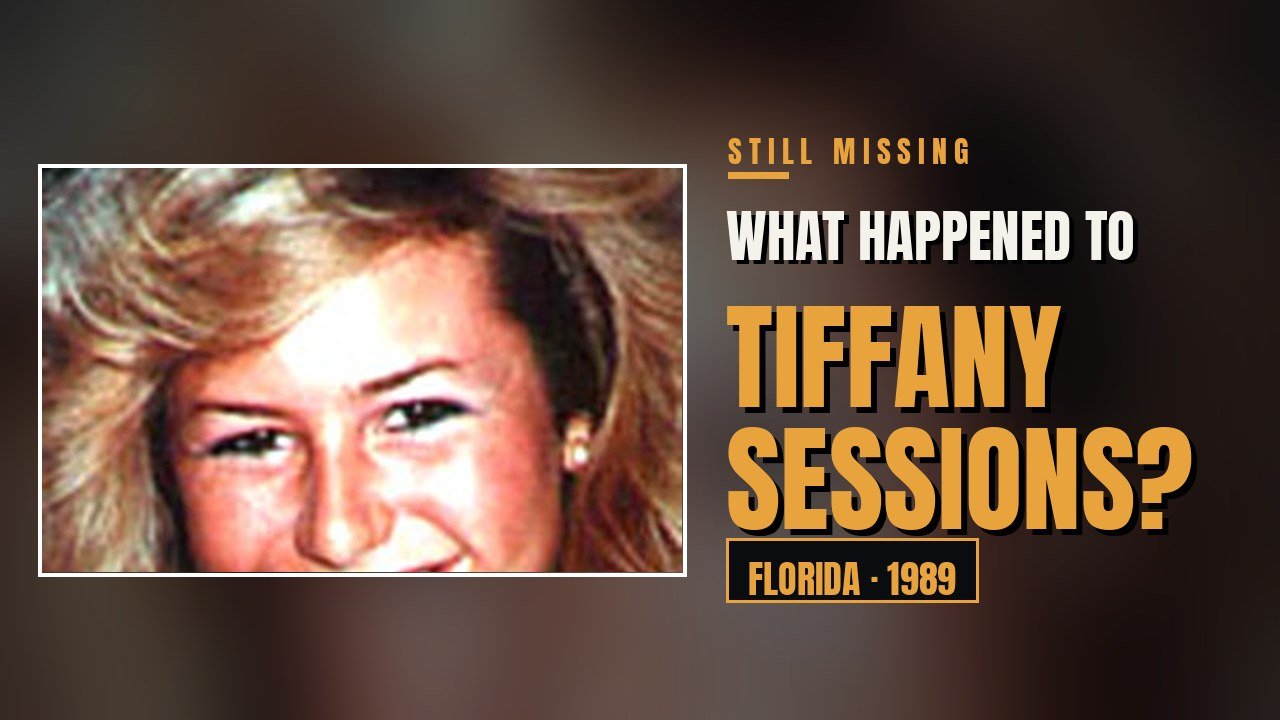
- Name: Tiffany Louise Sessions (“Tiffy”)
- Born: October 29, 1968, Tampa, Florida
- Age at disappearance: 20
- Last seen: February 9, 1989
- Location: SW 35th Place / Williston Road, Gainesville, Florida
- Height / build: 5’3″, blonde hair; last seen in a white “Aspen” sweatshirt, red sweatpants, tennis shoes, a two-tone Rolex, carrying a Sony Walkman
- Status: Still missing — declared legally dead in 1994; one of 28 cold cases at the Alachua County Sheriff’s Office; 3,000+ leads pursued
- Reward: $250,000 posted for her safe return
- Investigating agency: Alachua County Sheriff’s Office, (352) 367-4161
The power walk
On the afternoon of Thursday, February 9, 1989, Tiffany Sessions told her roommate she was going out for a power walk. The 20-year-old University of Florida junior — a finance major, on a health kick since winter break, slimming down for a ski trip with her father — took the same route down Williston Road she’d taken many times. She promised she’d be back before her roommate had to leave for a 7 p.m. class. She took only her Sony Walkman. She left her wallet, her ID, and her keys in the apartment, expecting her roommate to let her back in.
She was wearing a white pullover sweatshirt with grey striping and “Aspen” printed on the collar, red sweatpants, tennis shoes — and a two-tone silver-and-gold Rolex, an anniversary edition with a blue face.
She never came back.
Tiffany was notoriously reliable. When 7:15 passed with no sign of her, her roommate knew something was very wrong. Five hours after Tiffany left, the roommate called Tiffany’s mother. Police didn’t initially treat it as a crime — there was no crime scene, no sign she’d ever left the apartment parking lot, no sign of a struggle. People in the area said someone matching her description had been seen speaking with individuals inside a vehicle. Nobody could say whether she’d gotten in.
What followed was, by the FBI’s account, the largest search in Florida history. And then the decades.
Five million flyers
Tiffany’s mother, Hillary Sessions — Tiffany was her only child — turned grief into a campaign of staggering scale. Nearly five million flyers went out, locally, nationally, internationally. A $250,000 reward was posted. The case drew national attention, helped by who Tiffany was: the daughter of prominent executive Patrick Sessions, and the goddaughter of Louis Freeh, the future FBI director.
The reward brought mostly bogus information — two people were caught and jailed for extortion. Because Tiffany was over the age cutoff for a “missing child,” only one national agency would take her case at first: a center that accepted no government funding. It wasn’t until Suzanne’s Law passed in 2003 — fourteen years after she vanished — that Tiffany was entered into NCMEC’s database, with an age-enhanced image at 39. (Her mother’s own account describes the NCMEC entry as coming “nearly eighteen years” after her disappearance, dating it to the age-enhancement at 39 rather than the law’s 2003 passage; this article uses the 2003 legislative date.)
The case migrated from the Alachua County Sheriff’s Office to the Florida Department of Law Enforcement and back to Alachua County, where it sits today as one of 28 cold cases. More than 3,000 leads have been followed. New ones still come in.
Hillary Sessions has never moved. “Because Tiff would only know to come back to my house,” she said. “I have not moved since before she disappeared.”
The suspects
Paul Rowles. In February 2014 — twenty-five years after Tiffany vanished — investigators named convicted murderer Paul Rowles as a suspect in her kidnapping and presumed murder. Rowles had kept an address book, discovered in January 2013, with a cryptic entry investigators believed corresponded to Tiffany’s disappearance. In 2012, his DNA had been matched to the crime scene of another murdered college student, Elizabeth “Beth” Foster, killed in 1992 just a mile from where Tiffany walked. Rowles allegedly confessed to killing Tiffany, then recanted details. He died in 2013, a month after the address book surfaced. Prosecutors never had enough to charge him. Some investigators still believe he did it.
Michael Knickerbocker. A convicted murderer who claimed he killed Tiffany and buried her body near Fort Myers. No substantial evidence ever confirmed it. He died in prison.
Danny Rolling. The Gainesville Ripper, who murdered five UF students in 1990 — a year and a half after Tiffany vanished — was investigated and ruled out.
Wayne Porter. A convicted murderer who gave investigators a detailed confession. It fell apart under scrutiny.
The blood-soaked material. In August 2002, investigators searched a specified location and recovered a piece of blood-soaked material, testing it for Tiffany’s DNA. The results were never publicly announced.
The girl in the road. In 2013, a woman came forward: on the night of February 10, 1989 — the night after Tiffany vanished — she was sixteen, driving to her father’s house a few miles north of Gainesville, when she rounded a curve in a rural wooded area about ten miles outside the city and saw a distressed blonde girl run into the middle of the road.
Thirty-seven years. A walk that should have taken an hour. A mother who never moved, in case her daughter comes home.
Theories: what might have happened
Abduction by a predator on Williston Road. The witness account of Tiffany speaking with people in a vehicle is the closest thing to a last sighting, and the Rowles theory gives it a name: a convicted killer active in Gainesville, with a cryptic notebook entry and a second victim a mile away. What undercuts a charge: Rowles is dead, the confession was recanted, and the notebook entry is suggestive, not conclusive.
A different killer. Knickerbocker’s claim, Porter’s collapsed confession, Rolling’s ruled-out involvement — Gainesville in that era had no shortage of violent men. The danger of the Rowles focus is the same as the danger of any single-suspect theory: it can blind investigators to the others.
She is alive. Her mother has never moved, holding the door open for thirty-seven years. Against it: no contact, no credible sighting, no use of her identity in nearly four decades, and a young woman who left her keys behind expecting to be let back in within the hour.
Tiffany Sessions would turn 58 this month. Somewhere there is a blue-faced Rolex that was never recovered, a Walkman that never played again, and five million flyers that never brought her home.
Have information?
Contact the Alachua County Sheriff’s Office at (352) 367-4161. In an emergency, dial 911.
Timeline
- October 29, 1968 — Tiffany Louise Sessions is born in Tampa, Florida.
- February 9, 1989, 4:00–5:00 p.m. — Tiffany leaves her Casablanca East apartment for a power walk down Williston Road, promising to return by 7 p.m.
- February 9, 1989, evening — She doesn’t return; her roommate alerts her mother after five hours.
- 1989 — The FBI calls it the largest search in Florida history; $250,000 reward posted; flyers distributed worldwide.
- 1990 — Danny Rolling murders five UF students; investigated in Tiffany’s case, ruled out.
- 1992 — Elizabeth “Beth” Foster murdered a mile from Tiffany’s walking route.
- 1994 — Tiffany is declared legally dead.
- 2002 — Investigators recover blood-soaked material from a searched location; DNA results never announced.
- 2003 — Suzanne’s Law allows Tiffany’s entry into NCMEC with an age-enhanced image.
- 2012 — Rowles’s DNA matched to the Beth Foster crime scene.
- February 2014 — Paul Rowles named as a suspect; he died in 2013.
- Today — Still missing; one of 28 ACSO cold cases.
FAQ
Is Tiffany Sessions still missing?
Yes. As of October 2026, Tiffany Sessions has been missing for more than 37 years. Her case is one of 28 cold cases at the Alachua County Sheriff’s Office, with over 3,000 leads pursued.
Was Tiffany Sessions ever found?
No. Despite the largest search in Florida history, a $250,000 reward, and nearly five million flyers, no trace of Tiffany has ever been found.
How old would Tiffany Sessions be today?
Tiffany was born October 29, 1968 — she turns 58 on October 29, 2026.
Who was the suspect in Tiffany Sessions’ disappearance?
In 2014, convicted murderer Paul Rowles was named as a suspect; his address book contained a cryptic entry believed to reference her, and his DNA was matched to the murder of Elizabeth “Beth” Foster, killed near Tiffany’s route. He died in 2013 and was never charged. Other claimants — Michael Knickerbocker, Wayne Porter — were discredited, and Danny Rolling was ruled out.
What was Tiffany Sessions wearing?
A white “Aspen” sweatshirt, red sweatpants, tennis shoes, a two-tone silver-and-gold Rolex with a blue face, and she carried a black Sony Walkman. She left her wallet, ID, and keys at home.
How can I help?
Share this case file. If you have any information, contact the Alachua County Sheriff’s Office at (352) 367-4161.
Sources
- Reference: Wikipedia, “Disappearance of Tiffany Sessions” (retrieved Oct 2026); The Charley Project; NCMEC.
- News: Gainesville Sun archives; Jenn Baxter, “Gone Too Long: What Happened to Tiffany Sessions?” (Medium, 2022).
- Advocacy: The Surviving Parents Coalition, “Hilliary Sessions” (spcoalition.org) — the family’s account; Solve the Case, “Tiffany Louise Sessions” (case timeline).
Corrections (October 2026 fact-check): minor — corrected “eighteen years after she vanished” to “fourteen years” for the 2003 passage of Suzanne’s Law (2003 − 1989 = 14; the mother’s own account dates the NCMEC entry to “nearly eighteen years,” apparently referencing the age-39 enhancement rather than the law); corrected “Beth Foster” to Elizabeth “Beth” Foster (Wikipedia; FutonCritic). Disclosure: the mother’s first name is spelled “Hillary” in this article per Wikipedia, but appears as “Hilary” in her own advocacy writing (spcoalition.org) and in documentary sources — the spelling varies across sources. Birthplace is listed as Tampa per the article’s sources; Wikipedia’s infobox lists Miami — conflict noted. Found an error? Tell us via the About page and we will fix it promptly and note the change here. Last verified October 2026.