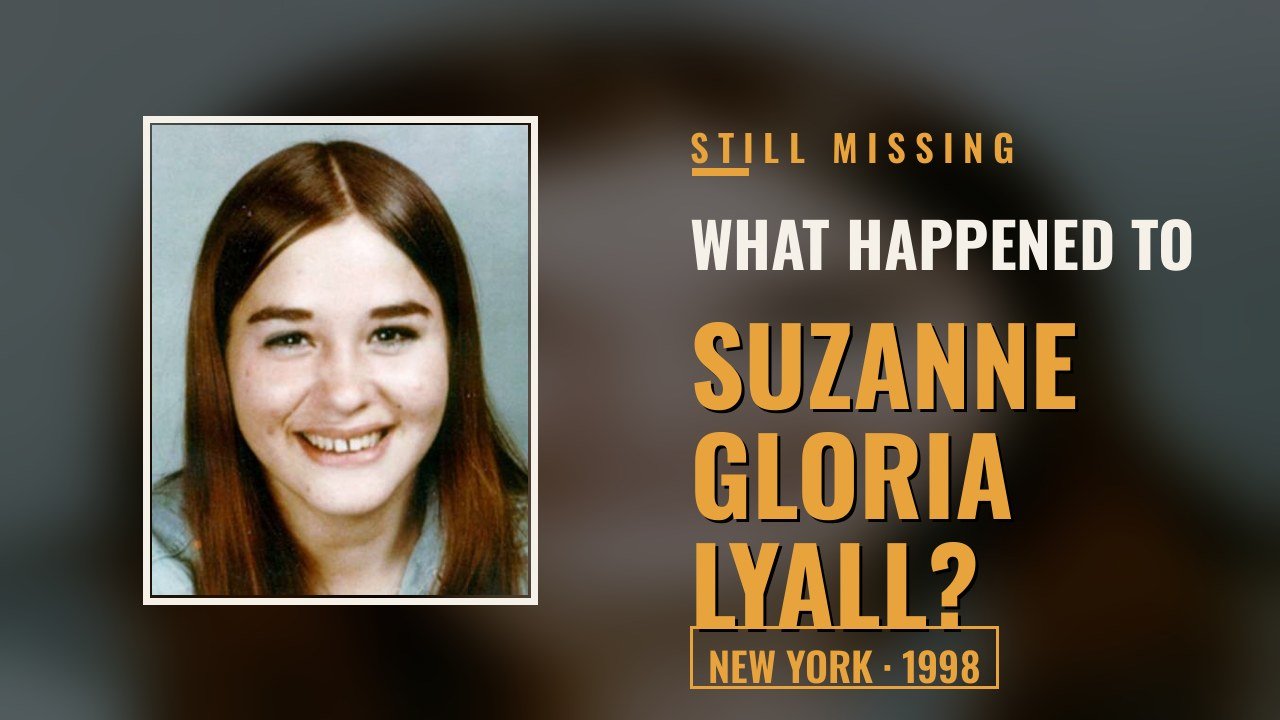
Key facts
- Name: Suzanne Gloria Lyall
- Born: April 6, 1978, Saratoga Springs, New York
- Age at disappearance: 19
- Last seen: March 2, 1998, ~9:45 p.m.
- Location: Collins Circle bus stop, SUNY Albany Uptown Campus, Albany, New York
- Height / build: 5’3″, 165–175 lbs, dark blonde hair, blue eyes
- Status: Still missing — NYSP investigation open; “we believe it’s a homicide” (2018)
- Case numbers: NCIC M-103085795; NYSP case 98-164
- Investigating agency: New York State Police
The bus stop
On the night of March 2, 1998, Suzanne Lyall worked her shift at the Babbage’s computer store in Crossgates Mall until the 9 p.m. closing, then boarded a Capital District bus back to campus, the way she always did. The driver — who worked that route regularly — later confirmed she got on. He could not say with certainty that she got off at Collins Circle, the stop a short walk from her dorm. He could only say she wasn’t on the bus when it reached the end of the line downtown.
A classmate said she saw Suzanne step off at Collins Circle around 9:45 p.m.
Her suitemates never heard her keys. Suzanne’s keys and fobs jingled; they always heard her come in. That night: silence.
The next morning, her boyfriend Richard Condon called her parents. Suzanne hadn’t returned to her dorm. She hadn’t answered his calls. She called or emailed her parents, or Condon, almost every day. This was not like her.
“Suzie was not a risk-taker,” her father Doug said. “She didn’t party or use alcohol or drugs.”
Campus police told the Lyalls not to worry — brief absences were common for college students. An officer went to her next class. She wasn’t there. Two days later, after she missed another midterm and more classes, campus police finally called in the New York State Police.
By then, her bank had already told the Lyalls something strange: Suzanne’s debit card had been used at 4 p.m. that afternoon — at an ATM in a Stewart’s Shops convenience store, two miles southeast of campus, in a part of Albany she didn’t frequent. Twenty dollars. Withdrawn with the correct PIN.
Who Suzanne was
Suzanne Gloria Lyall was the youngest of Doug and Mary Lyall’s three children, raised in Ballston Spa. Her older siblings called her “the darling of the family” — a quiet girl who would run out of the shower, hair still wet, to write poetry in her notebook when inspiration struck. She was a fan of the Canadian band Rush. She built computers from scratch.
She graduated from Ballston Spa High School with honors in 1996, spent a year at SUNY Oneonta, then transferred to SUNY Albany because Oneonta’s computer science courses weren’t challenging enough. She worked two jobs — a computer company in Troy, and Babbage’s in the mall — and talked to her parents nearly every day. The last time Mary actually spoke to her, March 1, Suzanne had complained about being low on cash before her next paycheck. She turned down her mother’s offer of a loan.
She’d been stressed about a midterm. She took it the morning of March 2. Her manager said she felt she’d “done OK” and seemed subdued. She went to classes until 4, then to work. Everything about that day was ordinary — until the bus.
The $20
The ATM withdrawal became the case’s gravitational center. The Stewart’s had a security camera, but it pointed at the cashier, not the ATM. Whoever used the card knew the PIN. Condon said only he and Suzanne knew it. And Suzanne, her parents said, always withdrew exactly $20 — never more, never less.
Police sought a man in a Nike baseball cap who’d used the ATM around the same time. They found him. They decided he had nothing to do with it — though they couldn’t exclude him entirely.
Then the bank records showed something else: two more $20 withdrawals on March 2 itself — one in the morning at a machine near the Collins Circle bus stop, one at the mall around the time she’d have arrived for work. Both were probably hers. Mary couldn’t imagine why her daughter would make two withdrawals in one day.
In May, her Babbage’s name tag turned up in a parking lot about 90 feet from the bus stop — in the opposite direction from her dorm. Police couldn’t determine how long it had been there. No forensic evidence.
A coworker told investigators Suzanne had said, about a month before she vanished, that she believed she was being stalked by someone she didn’t know. She hadn’t seemed afraid.
The boyfriend
Richard Condon was never fully ruled out, and the reasons why read like a true-crime outline. He had an alibi — playing video games with a friend, confirmed — for the night she disappeared. But after his initial conversations with police, he refused a polygraph, said he’d only be interviewed again with a lawyer present, and refused to answer media questions for years. His mother told CBS in 2010 he’d married and moved on.
He told police Suzanne was his fiancée. The Lyalls — who heard from their daughter almost daily — had never heard a word about an engagement. Mary told CBS News that Suzanne had tried to end the relationship several times, but would stay when Condon became emotional. Two weeks before she vanished, on a trip with her mother, Suzanne had asked to stop at Condon’s house to drop off a Valentine’s Day card. Mary later wondered if it had actually been a “Dear John” letter.
Police also looked at a convicted rapist who’d violated parole and left the area around that time — interviewed after his return from Illinois, excluded. They looked at John Regan, arrested in 2005 trying to drag a Saratoga Springs High School girl into his van, already facing trial for a 1993 Connecticut kidnapping. He refused to discuss Suzanne’s case. And they looked for a connection to Karen Wilson, another SUNY Albany undergraduate who’d vanished getting on a bus thirteen years earlier, in 1985. None was found.
In 2018, Senior Investigator John Camp said what investigators had long believed: “We believe it’s a homicide.”
What her parents built
Doug and Mary Lyall turned their grief into law. They founded the Center for Hope to support families of the missing. They were in the room when President George W. Bush signed Suzanne’s Law — part of the 2003 PROTECT Act — raising from 18 to 21 the age at which police must report a missing person to the National Crime Information Center. Five years later, Bush signed the Suzanne Lyall Campus Safety Act, requiring college police departments to have plans for investigating missing-person cases. New York had passed its own version the year after Suzanne vanished.
Doug died in 2015. Mary kept going — the activism, the searches, the book of Suzanne’s poetry. Over the years, 75 psychics contacted the family. In 2016, Mary told the Daily Gazette she’d always felt something was wrong driving over the Crescent Bridge across the Mohawk River; a local firm mapped the river bottom with high-tech sonar. Nothing significant was reported found.
In 2023, the State Police confirmed what the family already knew: the investigation is ongoing, still categorized as a missing person. Still no arrest. Still no Suzanne.
Theories: what might have happened
Abduction near the bus stop. The name tag 90 feet in the wrong direction, the bus driver’s uncertainty about whether she got off, the coworker’s stalking comment — it all points to the walk between Collins Circle and her dorm. The 2018 “we believe it’s a homicide” assessment reflects this. But no witness, no forensic evidence, no suspect has ever been attached to it.
The boyfriend. Condon had an alibi, and an alibi confirmed by a friend is still an alibi. But the refused polygraph, the lawyer-only stance, the “fiancée” claim the family never heard, the maybe–Dear John letter — police have never been able to fully rule him out, and that inability is itself a fact of the case. He has never been charged, and the presumption of innocence applies.
A stranger — possibly a serial offender. Regan was a real possibility with the wrong geography and the wrong answer (silence). The paroled rapist was excluded. Karen Wilson’s 1985 case is the eerie echo: same university, same bus-stop circumstances, no connection found.
Voluntary disappearance. Nothing supports it. She missed midterms, left her routine, never touched her bank account again after March 3, and called her parents daily. People who vanish on purpose usually take something with them. Suzanne took nothing.
Have information?
Contact the New York State Police at 1-800-920-4150, or the Center for Hope. In an emergency, dial 911.
Timeline
- April 6, 1978 — Suzanne Gloria Lyall is born in Saratoga Springs, New York.
- 1996 — Graduates Ballston Spa High School with honors; attends SUNY Oneonta.
- 1997 — Transfers to SUNY Albany for computer science.
- February 1998 — Tells a coworker she believes she’s being stalked; doesn’t seem afraid.
- March 1, 1998 — Last phone call with her mother; low on cash, declines a loan.
- March 2, 1998, morning — Takes her midterm; attends classes until 4 p.m.
- March 2, 1998, 9:00 p.m. — Finishes her shift at Babbage’s, Crossgates Mall; boards the CDTA bus ~9:20.
- March 2, 1998, ~9:45 p.m. — Classmate reports seeing her exit at Collins Circle. Never seen again.
- March 3, 1998 — Reported missing; campus police initially unconcerned.
- March 3, 1998, 4:00 p.m. — Her debit card is used at a Stewart’s Shops ATM, $20, correct PIN.
- March 5, 1998 — NYSP takes the case; $15,000 reward posted; 270 leads, 300 acres searched.
- May 1998 — Her Babbage’s name tag found 90 feet from the bus stop.
- 1999 — New York passes campus missing-person legislation; Lyalls found the Center for Hope.
- 2003 — Suzanne’s Law signed (PROTECT Act); 2008 — Suzanne Lyall Campus Safety Act signed.
- 2012 — Investigation Discovery’s Disappeared profiles her case.
- 2015 — Doug Lyall dies; Mary continues the search and activism.
- 2018 — NYSP Senior Investigator John Camp: “We believe it’s a homicide.”
- 2023 — NYSP confirms the investigation is ongoing.
- Today — Still missing.
FAQ
Is Suzanne Lyall still missing?
Yes. As of October 2026, Suzanne Lyall has been missing for more than 28 years. The New York State Police confirmed in 2023 that the investigation remains open and active.
Was Suzanne Lyall ever found?
No. No trace of Suzanne has ever been found. In 2018, a senior NYSP investigator said, “We believe it’s a homicide,” but no one has been charged.
Who was Suzanne Lyall’s boyfriend?
Richard Condon, a fellow student several years her senior whom she’d dated since high school. He had a verified alibi for the night she disappeared but later refused a polygraph and would only speak to police with a lawyer present. Police have never fully ruled him out. He has never been charged with any crime.
What is Suzanne’s Law?
A federal law, enacted as part of the 2003 PROTECT Act, that raised from 18 to 21 the age at which local police must notify the National Crime Information Center about a missing person. It was named for Suzanne Lyall after her parents’ advocacy. A second law, the Suzanne Lyall Campus Safety Act (2008), requires college police departments to maintain missing-person investigation plans.
How old would Suzanne Lyall be today?
Suzanne was born April 6, 1978 — she turned 48 in April 2026.
How can I help?
Share this case file. If you have any information, contact the New York State Police at 1-800-920-4150.
Sources
- Official / law enforcement: New York State Police (case 98-164; NCIC M-103085795); Center for Hope (hope4themissing.org).
- News: Daily Gazette (Schenectady, 2016); CBS News (2010); KGW/Portland (2017, via case comparisons).
- Reference: Wikipedia, “Disappearance of Suzanne Lyall” (retrieved Oct 2026).
- Media: Disappeared, Investigation Discovery (2012); Detective Perspective podcast, “MISSING: Suzanne ‘Suzy’ Lyall” (2026).
Found an error? Tell us via the About page and we will fix it promptly and note the change here. Last verified October 2026.