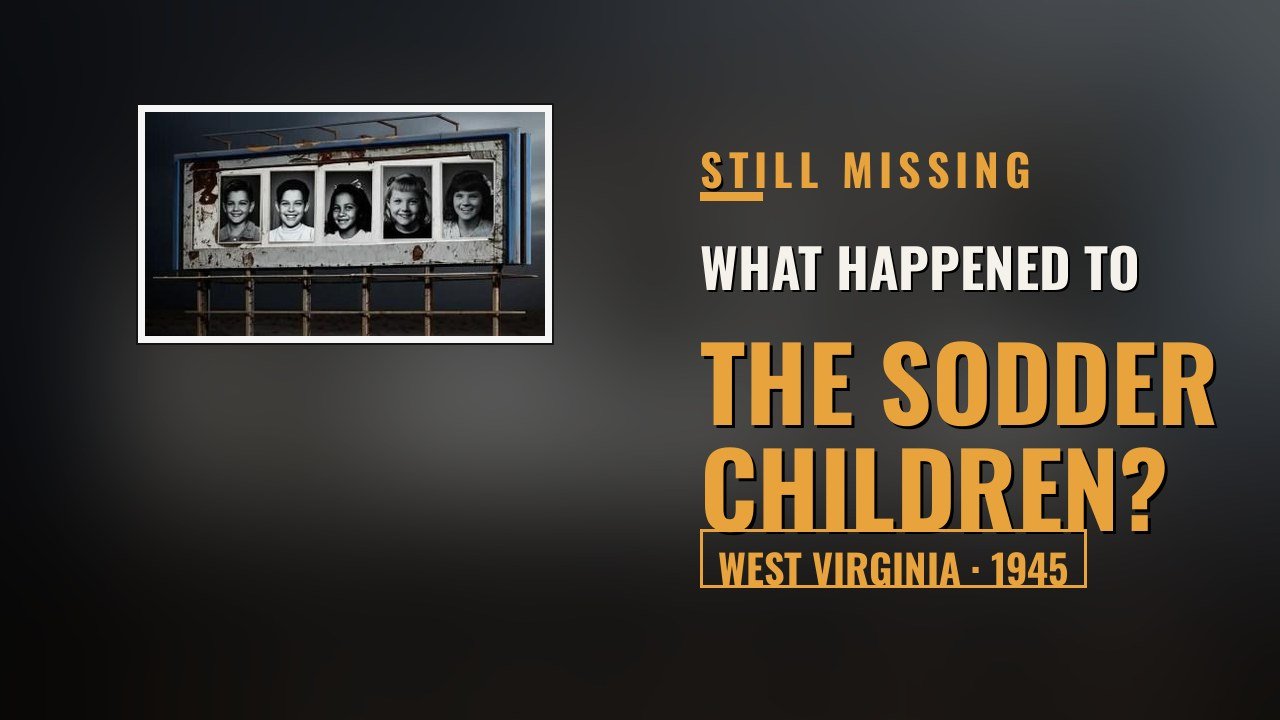
Key facts
- Names: Maurice Sodder (14), Martha Lee Sodder (12), Louis Sodder (9 — Wikipedia’s infobox lists 10; sources conflict), Jennie Irene Sodder (8), Betty Dolly Sodder (5)
- Last seen: December 24–25, 1945
- Location: Family home, two miles north of Fayetteville, West Virginia
- Status: Still missing — death certificates issued December 30, 1945, disputed by the family
- Reward: $5,000, later doubled to $10,000; family billboard stood on U.S. Route 19 (now State Route 16) from 1952 to 1989
- Investigating agency: Originally Fayetteville authorities / West Virginia State Police; state case closed as “hopeless” in 1950; FBI dropped it after two years
The fire that left no bodies
At 12:30 on Christmas morning, 1945, the telephone rang in the Sodder house outside Fayetteville, West Virginia.
Jennie Sodder went downstairs to answer. A woman she didn’t know was on the line, asking for a name Jennie didn’t recognize, laughing a laugh Jennie would later call weird. Glasses clinked in the background. Wrong number. Jennie hung up, noticed the lights were still on and the curtains undrawn — things her children always handled — and went back to bed.
Half an hour later, a bang on the roof woke her again. Something heavy had struck it, then rolled. She fell back asleep. At around 1:30, she woke to the smell of smoke. The fire was in George’s office, around the telephone line and the fuse box.
What happened in the next hour has been argued about for eighty years. George and Jennie got out with four of their children — Marion, 19; John, 22; George Jr., 16; and little Sylvia, 3. They screamed up the stairwell for the other five. Nobody answered. The stairs were already burning.
Five children — Maurice, 14; Martha, 12; Louis, 9; Jennie, 8; Betty, 5 — were upstairs in the attic bedroom. They never came down. And when the house finished burning, sometime in the dark hours before dawn, there was no sign they had ever been in it at all.
That is the whole mystery, and it has never been solved: a fire that should have left five small skeletons left nothing. By 10 a.m. on Christmas morning, the fire chief told the Sodders he had found no bones. He said the fire had been hot enough to burn the children’s bodies completely.
Jennie Sodder spent the rest of her life trying to prove that was impossible.
Who the Sodders were
George Sodder had been born Giorgio Soddu in Tula, Sardinia, in 1895, and came to America at thirteen with an older brother who turned straight around and went home. George stayed. He worked the railroads in Pennsylvania, drove trucks in Smithers, West Virginia, and eventually built his own hauling company — dirt first, then coal. He married Jennie Cipriani, a storekeeper’s daughter from Smithers who had also emigrated from Italy as a child, in 1922. They settled in a two-story timber-frame house two miles north of Fayetteville, in a community thick with Italian immigrants, and had ten children.
By all accounts they were, in one local official’s words, “one of the most respected middle-class families around.” George had opinions, though, and he aired them. His loudest was his hatred of Benito Mussolini — and in a town full of Italian immigrants, not everyone wanted to hear it. The dictator had been deposed in 1943 and executed in 1945, but the arguments George had started didn’t die with him.
Two months before the fire, a life insurance salesman came to the house. George turned him away. The salesman warned him that his house “[would go] up in smoke … and your children are going to be destroyed” — all because of, as he put it, “the dirty remarks you have been making about Mussolini.” Around the same time, a man who came asking for work walked around to the back of the house and told George his fuse boxes would “cause a fire someday” — strange, since George had just had the house rewired when an electric stove was installed, and the power company had pronounced it safe. In the weeks before Christmas, George’s older sons noticed a strange car parked along the main highway, its occupants watching the younger children walk home from school.
Christmas Eve itself was happy. Marion, the oldest daughter, had been working at the dime store in Fayetteville and surprised her three younger sisters with new toys. The little ones begged to stay up late. At 10 p.m. Jennie said yes — as long as Maurice and Louis remembered to put the cows in and feed the chickens. George, John, and George Jr. had worked with their father all day and were already asleep. Jennie took Sylvia upstairs to bed.
Nobody in that house knew it was the last ordinary night they would ever have.
Everything that went wrong at once
After the smoke woke her, Jennie’s account becomes a catalog of small impossibilities.
The phone was dead. Marion ran to a neighbor’s house to call the Fayetteville fire department. A driver passing on the road saw the flames and tried calling from a nearby tavern — that phone was broken too. Somebody eventually got through from a phone in the center of town, but the department, short on manpower because of the war and with no siren to summon its own men, didn’t get a truck to the Sodder house until around 8 a.m. — seven hours after the fire started. The fire chief later admitted he couldn’t even drive the truck himself and had to wait for someone who could.
George, barefoot, tried to climb the outside wall and broke a window, cutting his arm. The ladder that always leaned against the house was gone — the family later found it at the bottom of an embankment, 75 feet away. A water barrel that might have helped fight the fire was frozen solid. George tried to drive his two business trucks up to the house so his sons could climb to the attic window. Both trucks, which had run perfectly the day before, wouldn’t start.
The six who got out stood in the December cold and watched the house burn down and collapse over the next 45 minutes.
Later, a telephone repairman told the Sodders something that changed the shape of the case: the line hadn’t burned through. It had been cut — by someone willing and able to climb fourteen feet up the pole and reach two feet out to do it. A neighbor had seen a man stealing a block and tackle from the property around the time of the fire. He was arrested, admitted the theft, and claimed he’d cut the phone line thinking it was a power line. He denied any part in the fire. No record identifying him exists, and nobody ever explained why a thief would cut a phone line. Jennie said in 1968 that if he’d cut the power line instead, she, George, and the other four children would never have gotten out.
Four days after the fire, George couldn’t stand the sight of the ruins anymore. Against the fire chief’s instructions to leave the site undisturbed for the state fire marshal, he bulldozed five feet of dirt over it and planted a memorial garden. The coroner’s inquest the next day ruled the fire an accident caused by “faulty wiring.” Sitting on the jury was the insurance salesman who had threatened George’s children.
Death certificates for all five children were issued on December 30. The local paper managed to contradict itself in a single story — first saying all the bodies had been found, then reporting that only part of one body had been recovered. George and Jennie were too grief-stricken to attend the funeral on January 2, 1946.
The mother who did the math
Jennie Sodder could not accept the official story, and she attacked it the way a careful person attacks anything: with evidence.
If faulty wiring caused the fire, why had the Christmas lights stayed on through the early stages, when the power should have died? If the children’s bodies had burned completely, why were household appliances still recognizable in the ash, along with fragments of the tin roof? She read a newspaper account of a similar house fire that killed a family of seven — skeletal remains of every victim had been found. She burned small piles of animal bones herself, to see if they would be consumed completely. None ever were. An employee of a local crematorium told her human bones survive even after two hours at 2,000 degrees — far longer and hotter than the Sodder house fire could have been.
And then the sightings started.
A bus driver who passed through Fayetteville late that Christmas Eve said he’d seen people throwing “balls of fire” at the house. Months later, after the snow melted, little Sylvia found a small, hard, dark-green rubber ball-like object in the brush nearby. George said it looked like a “pineapple bomb” — a hand grenade or incendiary device.
A woman watching the fire from the road said she’d seen some of the children peering out of a passing car while the house burned. Another woman, at a rest stop between Fayetteville and Charleston, said she’d served the children breakfast the next morning — and noted a car with Florida license plates in the parking lot. About a week after the fire, Ida Crutchfield, who ran a hotel in Charleston, said the children came in around midnight with two men and two women, all “of Italian extraction.” When she tried to talk to the children, she said, one of the men “looked at me in a hostile manner; he turned around and began talking rapidly in Italian. Immediately, the whole party stopped talking to me.” They left early the next morning.
The Sodders hired a private investigator, C.C. Tinsley of Gauley Bridge. He found that the threatening insurance salesman had sat on the coroner’s jury. He picked up rumors that the fire chief, despite telling the Sodders no remains were found, had recovered a heart, packed it in a metal box, and buried it in secret. Confronted, the chief showed George and Tinsley where he’d buried the box. They dug it up and took its contents to a funeral director, who told them it was fresh beef liver — never exposed to fire. Rumor later held that the chief had planted it himself, hoping the Sodders would find it and accept that the children had died.
The bones that raised more questions
In August 1949, George persuaded Oscar Hunter, a Washington pathologist, to supervise a proper excavation of the bulldozed site. They found a dictionary that had belonged to the children, some coins — and several small bone fragments, determined to be human vertebrae. They went to Marshall T. Newman, a Smithsonian specialist. His report said the vertebrae were lumbar, all from one person, aged about 16 or 17 — too old to be any of the five missing children, the oldest of whom, Maurice, had been 14. The bone showed no sign of exposure to flame. Newman called it “very strange” that these were the only bones found: a wood fire of that duration should have left full skeletons of all the children. He concluded the vertebrae had most likely arrived in the dirt George used to bulldoze the site. Tinsley later claimed the fragments had come from a cemetery in nearby Mount Hope — but couldn’t explain how they’d gotten to the fire site. The Smithsonian returned the fragments to George in September 1949. Their current location is unknown.
The excavation made national news. The West Virginia Legislature held two hearings in 1950. Then Governor Okey L. Patteson and the state police superintendent told the Sodders the case was “hopeless” and closed it at the state level. The FBI took it up as a possible interstate kidnapping and dropped it after two years of dead leads.
George Sodder tried the FBI himself. J. Edgar Hoover wrote back personally: “Although I would like to be of service, the matter related appears to be of local character and does not come within the investigative jurisdiction of this bureau.” The Fayetteville police and fire departments declined to request federal help.
The billboard
In 1952, the Sodders put up a billboard at the site of the house, on what is now State Route 16, carrying the five children’s pictures and offering a $5,000 reward — soon doubled to $10,000 — for information that would settle the case for even one of them. A second billboard went up along U.S. Route 60 near Ansted. The Route 16 sign became a landmark. It stood for 37 years.
Leads kept coming. A St. Louis woman claimed Martha was being held in a convent. A Texas bar patron claimed he’d overheard two men talking about a Christmas Eve fire in West Virginia. George once drove all the way to New York because a magazine photo of a young ballet dancer looked like Betty; the school wouldn’t let him see the girl.
In 1967, two things happened. A woman in the Houston area wrote that Louis had revealed his true identity to her one night after drinking too much, and that he and Maurice were both living in Texas. George and his son-in-law went down but couldn’t speak with her; police found the two men she’d named, and they denied being the missing sons. Years later, George’s son-in-law said doubts about that denial stayed with George for the rest of his life.
Then Jennie found a letter in the mail, postmarked Central City, Kentucky, no return address. Inside was a photograph of a young man of about thirty with features strongly resembling Louis — who would have been in his thirties. On the back, someone had written: Louis Sodder / I love brother Frankie / Ilil boys / A90132 or 35.
The family hired a detective to go to Central City. He never reported back, and they never found him again. They put the photograph on the billboard anyway — leaving Central City out of the published information, afraid Louis might come to harm — and hung an enlargement over their fireplace.
Late in 1968, George told the Charleston Gazette-Mail that the lack of information had been “like hitting a rock wall — we can’t go any further.” In another interview around then, he said: “Time is running out for us. But we only want to know. If they did die in the fire, we want to be convinced. Otherwise, we want to know what happened to them.”
George died in 1969. Jennie stayed in the family home, fenced it, added rooms, wore black for the rest of her life, and tended the garden on the bulldozed site until her death in 1989. Then the family took the weathered billboard down.
The youngest surviving sibling, Sylvia Sodder Paxton — three years old on the night of the fire, the last of the children to leave home — kept the case alive into the 21st century. “I experienced their grief for a long time,” she told the Gazette-Mail in 2013. Her daughter said in 2006: “She promised my grandparents she wouldn’t let the story die, that she would do everything she could.” Sylvia died in 2021. In 2022, the History Channel featured the case on History’s Greatest Mysteries.
Theories: what might have happened
They died in the fire. This is the official finding, and it has serious defenders. Local author George Bragg, who wrote about the case in his 2012 book West Virginia’s Unsolved Murders, leans toward it — noting that John Sodder’s original account, in which he said he went upstairs to physically wake his siblings before fleeing, may have been the truth. Journalist Stacy Horn, who covered the case for NPR’s 60th-anniversary segment, calls death in the fire the most plausible solution: the house smoldered all night after collapsing, the firefighters’ two-hour search of the ash was cursory at best, and they may not have known what they were looking for. As Bragg put it: “Logic tells you they probably did burn up in the fire, but you can’t always go by logic.” What undercuts it: Jennie’s bone experiments, the crematorium worker’s testimony, the recognizable appliances in the ash, and the 1949 vertebrae showing no fire exposure.
They were taken before or during the fire — possibly by organized criminals. The family’s theory, held for generations. The evidence they cite: the insurance salesman’s threat naming the children; the stranger warning about the fuse boxes; the strange car watching the children; the cut phone line; the missing ladder; the trucks that wouldn’t start; the fire chief not finding bones and then the beef-liver episode; the sightings at the rest stop and the Charleston hotel. The suspected motive: retaliation for George’s anti-Mussolini outspokenness, possibly involving the Sicilian Mafia, with the children taken back to Italy or raised elsewhere. What undercuts it: no direct evidence of a kidnapping was ever produced; some sightings (like Ida Crutchfield’s) are considered unreliable — she came forward years later, having first seen the children’s photos long after the fact; and a coordinated abduction of five children from a burning house without waking the parents strains belief.
Arson to cover something else. A middle theory: the fire was deliberately set — the “balls of fire,” the pineapple-bomb-like object, the fire starting on the roof, the sabotaged phones, ladder, and trucks — but the children died in it, and the arson was meant to look like an accident or to destroy evidence of some other crime. This fits the sabotage evidence without requiring a five-child kidnapping. What undercuts it: no motive for such an elaborate arson has ever been established beyond the Mussolini grudge, and the sightings of living children afterward would have to be entirely wrong.
The 1967 photograph shows Louis alive. The family treated this as their most credible lead. The resemblance, the handwritten “Louis Sodder” on the back, the Kentucky postmark with no return address — and the detective who vanished while investigating it. Against it: nothing was ever verified, the photo’s origin is unknown, and the writing (“Ilil boys,” “A90132 or 35”) reads as cryptic rather than confirmatory.
Horn’s summary still stands as the fairest verdict: “there is enough genuine weirdness about this whole thing … that if someday it is learned that the children did not die in the fire I won’t be shocked.”
Have information?
This case is more than eighty years old and officially closed at the state level, but tips can still be directed to the Fayetteville Police Department, Fayetteville, West Virginia, or to the FBI at 1-855-CALL-FBI (1-855-225-5324) or tips.fbi.gov. In an emergency, dial 911.
Timeline
- 1895 — Giorgio Soddu is born in Tula, Sardinia, Italy; he immigrates to America at 13 and becomes George Sodder.
- 1922 — George marries Jennie Cipriani; they settle near Fayetteville, WV, and eventually have ten children.
- October 1945 — A life insurance salesman threatens George over his anti-Mussolini remarks: his house “[would go] up in smoke … and your children are going to be destroyed.”
- December 24, 1945, evening — The family celebrates Christmas Eve; Marion surprises her younger sisters with toys.
- December 25, 1945, 12:30 a.m. — Wrong-number call with a woman’s “weird laugh.”
- December 25, 1945, ~1:00 a.m. — Loud bang on the roof; ~1:30 a.m., Jennie smells smoke; fire in George’s office.
- December 25, 1945, ~2:00 a.m. — Six family members escape; the house burns and collapses; five children unaccounted for; no bones found by 10 a.m.
- December 30, 1945 — Death certificates issued for all five children; the inquest rules the fire an accident from “faulty wiring.”
- 1946 — Sightings reported: children seen in a passing car; served breakfast at a rest stop; Ida Crutchfield’s Charleston hotel account.
- August 1949 — Excavation supervised by pathologist Oscar Hunter finds small bone fragments, judged not to be from the children and showing no fire exposure.
- 1950 — West Virginia Legislature holds two hearings; the governor and state police close the case as “hopeless.”
- 1952 — The family erects the billboard on Route 19 (now State Route 16) with a $5,000 reward, soon doubled to $10,000.
- 1967 — Houston tip about Louis and Maurice; letter postmarked Central City, Kentucky, arrives with a photograph believed to be an adult Louis.
- 1969 — George Sodder dies.
- 1989 — Jennie Sodder dies; the billboard comes down after 37 years.
- 2021 — Sylvia Sodder Paxton, the last surviving sibling who was in the house that night, dies.
- 2022 — History Channel’s History’s Greatest Mysteries features the case.
- Today — Still missing.
FAQ
Were the Sodder children’s bodies ever found?
No. No confirmed remains of Maurice, Martha, Louis, Jennie, or Betty Sodder have ever been found. Small bone fragments unearthed in a 1949 excavation were examined by a Smithsonian specialist, who concluded they belonged to a single person aged about 16 or 17, showed no exposure to fire, and most likely came from the dirt used to bulldoze the site.
What happened to the Sodder children?
Nobody knows. The official finding is that they died in the December 25, 1945, house fire, but the family disputed this for generations, citing the absence of remains, evidence of sabotage (a cut phone line, a missing ladder, trucks that wouldn’t start), pre-fire threats, and reported sightings of the children afterward. The case remains unsolved.
Is the Sodder children case still unsolved?
Yes. As of October 2026, more than eighty years after the fire, the disappearance of the five Sodder children is still unsolved. The state of West Virginia closed the case in 1950 and the FBI dropped it after two years, but the family continued investigating into the 21st century.
Was the Sodder fire arson?
The official ruling was accidental, caused by “faulty wiring.” The family believed it was deliberately set, pointing to a bus driver’s report of “balls of fire” being thrown at the house, a small incendiary-like object found nearby months later, the cut phone line, and the insurance salesman’s earlier threat. Arson was never proven.
What was the reward in the Sodder case?
The family initially offered $5,000 for information, soon doubling it to $10,000, advertised on a billboard along U.S. Route 19 (now State Route 16) in Fayetteville from 1952 until shortly after Jennie Sodder’s death in 1989.
Who were the five missing Sodder children?
Maurice Sodder (14), Martha Lee Sodder (12), Louis Sodder (9; some sources list 10), Jennie Irene Sodder (8), and Betty Dolly Sodder (5). Four siblings escaped the fire — Marion, John, George Jr., and Sylvia — and a tenth child, Joe, was away serving in the military.
Sources
- Reference: Wikipedia, “Sodder children disappearance” (retrieved Oct 2026).
- News: Smithsonian magazine, Karen Abbott, “The Children Who Went Up in Smoke” (Dec 25, 2012); NPR, Stacy Horn, “Mystery of Missing Children Haunts W.Va. Town” (Dec 23, 2005); Charleston Gazette-Mail, Niles Jackson, “What Really Happened to Children?” (Dec 22, 1968); Beckley Register-Herald, Audrey Stanton, “Where are the children?” (Dec 24, 2006).
- Media: History Channel, History’s Greatest Mysteries (2022 episode).
Found an error? Tell us via the About page and we will fix it promptly and note the change here. Last verified October 2026.
Note (October 2026): Sources conflict on Louis Sodder’s age — most list 9, while Wikipedia’s infobox lists 10. The file retains 9 with the conflict disclosed.