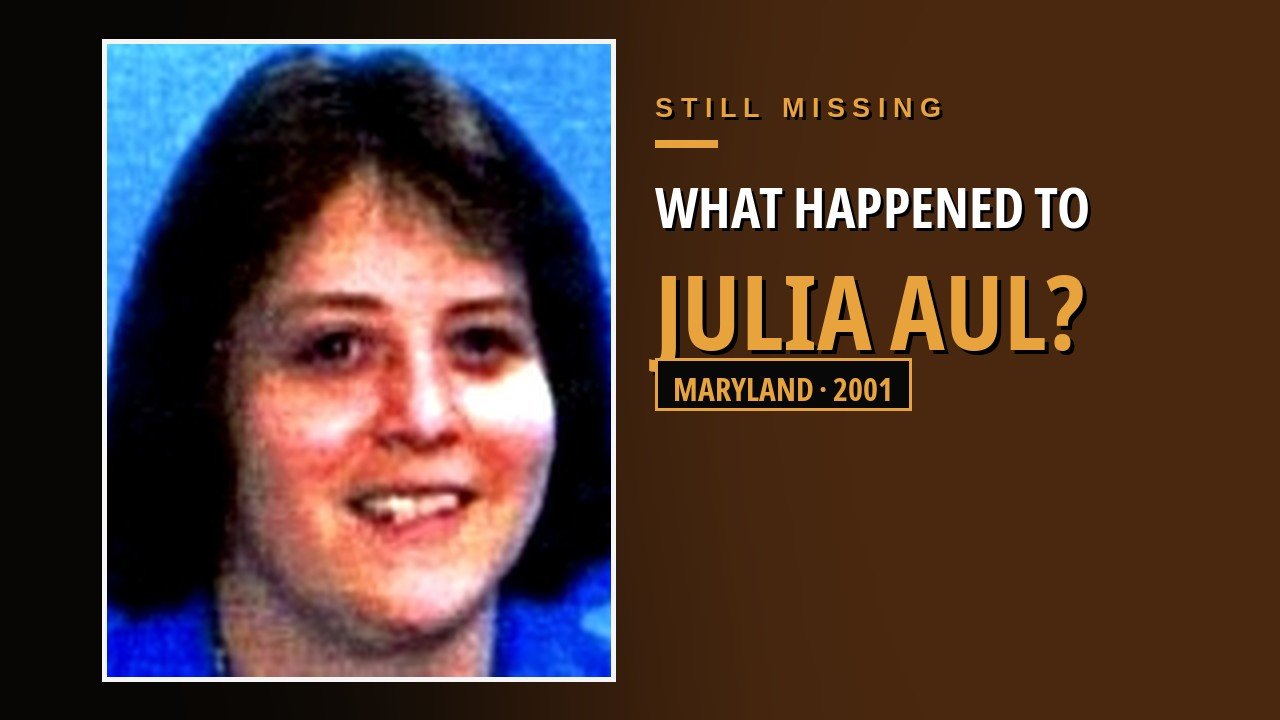
Key facts
- Name: Julia Christine Aul
- Born: June 18, 1961
- Age at disappearance: 39
- Last seen: January 9, 2001, in Havre de Grace, Maryland
- Location: Havre de Grace, Harford County, Maryland; her car was later found abandoned in Baltimore
- Description: 5’2″, 165 lbs, brown hair, blue eyes; tattoos: a rose and butterfly on her left breast, a woman’s face and half-moon under her right shoulder; wore a silver band ring with a triangle design; had schizophrenia (required medication) and a long-standing drug addiction
- Status: Still missing (NamUs MP10723)
- Investigating agency: Havre de Grace Police Department — 410-939-2121
The argument she walked away from
On January 9, 2001, Julia Aul went to visit her girlfriend at the Maryland Transportation Authority office in Havre de Grace. The two argued. Julia stormed off.
Her girlfriend was ruled out early — the argument, whatever it was about, ended with Julia leaving on her own. But Julia never came back. She had schizophrenia and needed medication. She had a long-standing drug addiction. She lived a transient life: no credit cards, no bank account, nothing anchoring her to the system that most people move through every day.
Days later, her blue 1997 Geo Tracker turned up abandoned in an area of Baltimore known for drug activity. There were no signs of foul play in or around the car. It was just empty — the last physical trace of Julia Aul.
A woman the system barely held
Julia’s life made her hard to find even before she vanished. At 39, she was transient, unbanked, and managing a serious mental illness that required medication she may not have been taking consistently. People in that position disappear from official view all the time — they just usually come back.
The abandoned Geo Tracker in Baltimore suggested a direction: toward the drug corridors of the city, toward the life her addiction had already been pulling her into. But the car yielded nothing. No signs of a struggle. No indication of where she’d gone after parking it — or whether she’d parked it at all.
Her tattoos were distinctive: a rose and butterfly on her left breast, a woman’s face and a half-moon under her right shoulder blade. She wore a silver band ring with a triangle design. These are the details that go on the posters, the ones meant to catch someone’s eye in a shelter or an emergency room — the places where a woman like Julia might surface.
She never surfaced. Her NamUs entry (MP10723) remains active. As of September 2026, missing-persons databases were still updating her listing. Twenty-five years on, the case is still open.
The argument and what it wasn’t
The argument at the Maryland Transportation Authority office on January 9, 2001, is the last documented human interaction of Julia Aul’s life — and investigators cleared it fast. Her girlfriend was ruled out. Whatever they fought about, it ended with Julia storming off, alive and angry. That matters because in missing-person cases, the last person to see the victim is always the first person examined. Here, the examination ended quickly, and the case moved on to the harder question: where does a transient woman with no bank account, no credit cards, and untreated schizophrenia go?
The answer, for a while, seemed to be Baltimore. The blue 1997 Geo Tracker turned up abandoned in a part of the city known for drug activity — no signs of foul play, no signs of anything. Just an empty car. For a woman with a long-standing drug addiction, the location fit a pattern: toward the supply, toward the life the addiction demanded. But cars don’t tell you whether the driver walked away or was taken away. They just sit there, empty, until someone runs the plates.
Julia’s tattoos were her best hope of being identified if the worst had happened: a rose and butterfly on her left breast, a woman’s face and half-moon under her right shoulder, a silver band ring with a triangle design. Unidentified-remains cases are solved on details exactly like these — a distinctive tattoo in a morgue log, matched years later to a missing-person file. In twenty-five years, no Jane Doe has matched Julia Aul. Her NamUs entry (MP10723) is still there, still waiting for the call that matches the tattoos to a name.
As of September 2026, missing-persons databases were still updating her listing. Someone is still tending the file. For a woman the system barely held in life, the system is holding her case with surprising care in death — or in whatever the truth turns out to be.
The vulnerability no one was tracking
Julia Aul belonged to a population that disappears without disappearing: transient adults with serious mental illness and addiction. In 2001, the systems for tracking such people were thin. No bank account means no transaction trail. No credit cards means no purchase history. No fixed address means no landlord to notice, no mail piling up, no neighbor to call. When Julia stormed out of the Maryland Transportation Authority office on January 9, 2001, she stepped out of the last structured interaction of her life and into a city where she was, functionally, invisible.
Her schizophrenia required medication — and medication requires routine, pharmacy access, stability. A transient life breaks all three. Whether she was medicated that January is unknown, but the trajectory is familiar to anyone who’s worked with unhoused mentally ill adults: the illness makes the transience worse, the transience makes the illness worse, and the people around them lose the thread.
The Geo Tracker in Baltimore is the hinge. An abandoned car in a drug-activity area, no signs of foul play — it reads like a woman who drove to the place her addiction pointed and then kept going on foot, or was taken from there. But “reads like” isn’t evidence. Twenty-five years later, the car is gone — impounded, auctioned, crushed, long since — and Julia’s file holds the tattoos, the ring, the description, and the date. The rest is the city’s silence.
Theories
Overdose or death in the margins
A transient woman with a drug addiction and untreated schizophrenia, last traced to a Baltimore drug-activity area — the risk of a fatal overdose, or death from exposure or violence, with no one to identify her, is real. Evidence level: Consistent with her circumstances, but no unidentified remains have ever been matched to Julia.
Foul play
She stormed off after an argument and drove to Baltimore. What happened between the argument and the abandoned car is unknown. Evidence level: The car showed no signs of foul play. Her girlfriend was ruled out. No suspects have ever been named.
She is alive and living off the grid
Some families of long-missing transient adults hold onto this. Evidence level: Julia required medication for schizophrenia and had no financial footprint — no bank account, no credit cards. Twenty-five years without a single confirmed contact makes this unlikely, though unidentified-persons cases are full of surprises.
Have information?
Contact the Havre de Grace Police Department at 410-939-2121.
In an emergency, dial 911.
Timeline
- June 18, 1961 — Julia Christine Aul is born.
- January 9, 2001 — Julia visits her girlfriend at the Maryland Transportation Authority office in Havre de Grace, argues, and storms off. She is never seen again.
- January 2001 — Her blue 1997 Geo Tracker is found abandoned in a Baltimore drug-activity area. No signs of foul play.
- September 2026 — Missing-persons databases update her listing; the case remains active (NamUs MP10723).
- Today — Still missing.
FAQ
Is Julia Aul still missing?
Yes. As of October 2026, Julia Aul remains missing. She vanished in January 2001 and has never been found.
Was Julia Aul ever found?
No. No trace of Julia has been found in the twenty-five years since she disappeared.
What happened to Julia Aul?
She was last seen on January 9, 2001, in Havre de Grace, Maryland, after arguing with her girlfriend and storming off. Her car was later found abandoned in Baltimore. What happened after that is unknown.
How old would Julia Aul be today?
She was born June 18, 1961, so she would be 65 years old in 2026.
What did Julia Aul look like?
She was 5’2″, 165 pounds, with brown hair and blue eyes. She had distinctive tattoos — a rose and butterfly on her left breast, a woman’s face and half-moon under her right shoulder — and wore a silver band ring with a triangle design.
Did Julia Aul have a mental illness?
Yes. She had schizophrenia and required medication, and she had a long-standing drug addiction. She lived a transient life with no bank account or credit cards.
Sources
Official / law enforcement:
– Havre de Grace Police Department — 410-939-2121
– NamUs — MP10723
Reference:
– Charley Project — case file: Julia Christine Aul (charleyproject.org/case/julia-christine-aul)
– marylandmissing.com — missing persons listings
Found an error? Tell us via the About page and we will fix it promptly and note the change here. Last verified October 2026.