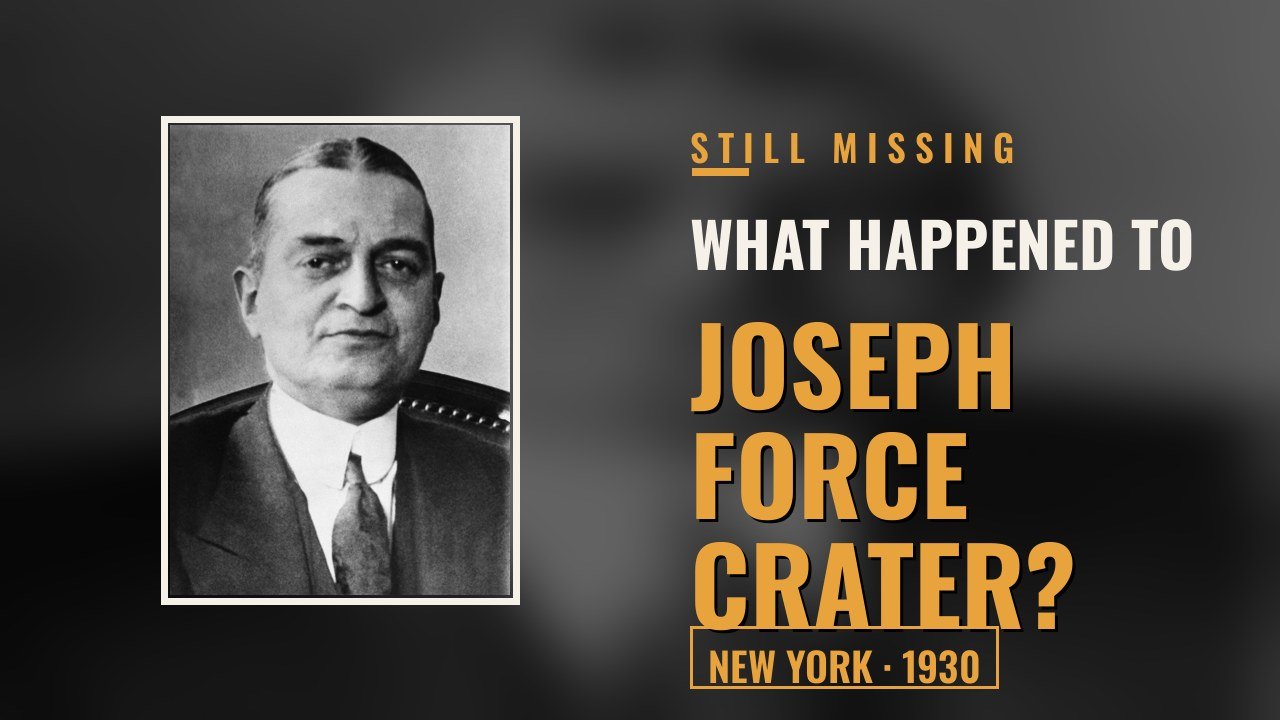
Key facts
- Name: Joseph Force Crater
- Born: January 5, 1889, Easton, Pennsylvania
- Age at disappearance: 41
- Last seen: August 6, 1930, ~9:30 p.m.
- Location: West 45th Street, Manhattan, New York City
- Height / build: 5’11”, ~185 lbs, brown hair, blue eyes
- Status: Still missing — declared legally dead June 6, 1939; missing-person file closed 1979; fate unknown
- Investigating agency: New York Police Department (case closed 1979)
The taxi on 45th Street
On the night of August 6, 1930, a New York State Supreme Court justice finished dinner at Billy Haas’s Chophouse at 332 West 45th Street, stepped outside with two companions — and got into the most famous taxi ride in American history.
Or maybe he didn’t. His dinner companions, showgirl Sally Lou Ritz and lawyer William Klein, first told police the judge “got into a taxicab outside the restaurant about 9:30 p.m. and drove west on Forty-fifth Street.” Then they changed the story: they’d taken the taxi, and Crater had walked.
Either way, Joseph Force Crater — 41 years old, four months into a judgeship handed to him by Governor Franklin D. Roosevelt, a man his friends called “Good Time Joe” — was never seen again.
His wife didn’t report him missing for weeks. His fellow justices grew alarmed when he failed to appear for the opening of the courts on August 25. The police were notified on September 3. By then, the trail was cold, and it has stayed cold for 96 years.
Who the judge was
Crater was born in Easton, Pennsylvania, the eldest of four children of Irish immigrants, educated at Lafayette College and Columbia. He married Stella Mance Wheeler in 1917 — seven days after her divorce was finalized, a divorce he’d helped arrange. He opened a law office in Manhattan’s Equitable Building, joined the Tammany Hall machine’s Cayuga Democratic Club, and worked his way up through the city’s Democratic machinery.
On April 8, 1930, Governor Roosevelt appointed him to the New York Supreme Court for New York County — a trial court, despite the grand name. He’d issued exactly two published opinions.
That spring, he’d liquidated $16,000 in investments and withdrawn $7,000 from his bank account — together about $340,000 in today’s money. The whispers said it was the price of the judgeship, paid to Tammany Hall. And in the summer of 1930, the state began the corruption investigation that would become the Seabury Commission.
The last days
The Craters were vacationing at their summer cabin in Belgrade, Maine, when the phone rang in late July. Crater told his wife nothing about the call except that he had to get back to the city “to straighten those fellows out.” The next day he was in New York — but instead of straightening anyone out, he went to Atlantic City with Sally Lou Ritz, a 22-year-old showgirl.
He returned to Maine on August 1, came back to the city on August 3, promising Stella he’d be home by her birthday, August 9. She said he was in good spirits, behaving normally.
On the morning of August 6, he spent two hours in his courthouse chambers going through his files — reportedly destroying several documents. He had his law clerk, Joseph Mara, cash two checks totaling $5,150 (about $77,000 today). At noon, the two men carried two locked briefcases to Crater’s apartment at 40 Fifth Avenue, and Crater gave Mara the rest of the day off.
That evening he stopped at a Broadway ticket agency run by his friend Joseph Gransky and reserved a single seat for a comedy called Dancing Partner at the Belasco — odd, because Gransky knew they’d already seen a preview together. Then dinner at the chophouse. Then the taxi. Then nothing.
The investigation
When detectives finally got the case, they found the judge’s safe deposit box emptied and the two locked briefcases gone from his apartment. The briefcases have never been found.
A grand jury convened in October 1930 heard 95 witnesses and produced 975 pages of testimony. Its conclusion was a masterpiece of uncertainty: “the evidence is insufficient to warrant any expression of opinion as to whether Crater is alive or dead, or as to whether he has absented himself voluntarily, or is the sufferer from disease in the nature of amnesia, or is the victim of crime.”
The case generated thousands of false sightings and a carnival of sideshows. Crater’s jacket turned up in the apartment of Vivian Gordon, a high-end prostitute connected to gangster Jack “Legs” Diamond. Gordon met with a Seabury Commission lawyer in February 1931 offering to testify about police graft — and was murdered five days later. In January 1931, Stella found envelopes of checks, stocks, bonds, and a note from her husband hidden in a dresser drawer that police had already searched. The letter began: “The following money is due me from the persons named. Get in touch with them for they will surely pay their debts.”
In 1937, Stella — living on $12 a week as a telephone operator in Maine — petitioned to have her husband declared dead. It was granted June 6, 1939. She collected $20,561 in life insurance, remarried, and died in 1969. She wrote her own account, The Empty Robe (1961), insisting her husband had been murdered.
The NYPD officially closed the missing-person file in 1979. But in August 2005, cold case detectives got one last lead: Stella Ferrucci-Good, a Queens woman who’d died at 91, left notes claiming her late husband — an NYPD detective — had learned Crater was killed by a crooked cop named Charles Burns and his brother Frank, and buried near West Eighth Street in Coney Island, at what is now the site of the New York Aquarium. Police noted no remains had ever been found there when the site was excavated in the 1950s. The lead went nowhere.
Theories: what might have happened
Murdered over corruption. The strongest circumstantial case: a Tammany judge vanishes weeks into a corruption probe, after emptying his safe deposit box and destroying files. The Seabury investigation eventually toppled Mayor Jimmy Walker and broke Tammany Hall. But no evidence of Crater’s corruption was ever found, and no killer was ever identified. The 2005 Coney Island burial claim is uncorroborated.
Voluntary disappearance. The emptied accounts, the packed briefcases, the single theater ticket, the destroyed documents — it all reads like a man arranging to vanish. But Crater left a wife expecting him home for her birthday, took no luggage anyone found, and never touched the money again. If he started over, he did it without a trace for 96 years.
Amnesia or accident. The grand jury listed it. Nothing supports it.
The blackmail theory. A lawyer for Stella argued that showgirl June Brice — seen with Crater the day before he vanished — was blackmailing him (explaining the bank withdrawals) and that her gangster boyfriend killed him. Brice vanished the day a grand jury was to convene; she surfaced in a mental hospital in 1948. Intriguing, unproven.
Ninety-six years on, “to pull a Judge Crater” still means to disappear. Nobody knows which verb applies to the man himself.
Have information?
The NYPD’s missing-person file was officially closed in 1979, but tips can still be directed to NYPD Crime Stoppers at 1-800-577-TIPS. In an emergency, dial 911.
Timeline
- January 5, 1889 — Joseph Force Crater is born in Easton, Pennsylvania.
- April 8, 1930 — Appointed to the NY Supreme Court by Gov. Franklin D. Roosevelt.
- Summer 1930 — The state corruption probe (soon the Seabury Commission) begins.
- Late July 1930 — The phone call at Belgrade Lakes, Maine: “to straighten those fellows out.”
- August 3, 1930 — Returns to New York City; promises his wife he’ll be back by August 9.
- August 6, 1930, morning — Two hours in chambers; $5,150 in cashed checks; two locked briefcases to his apartment.
- August 6, 1930, evening — Reserves a theater ticket; dines at Billy Haas’s Chophouse on West 45th Street.
- August 6, 1930, ~9:30 p.m. — Last seen outside the restaurant. Never seen again.
- September 3, 1930 — Police notified; the disappearance becomes front-page news.
- October 1930 — Grand jury: 95 witnesses, 975 pages, no conclusion.
- January 1931 — Stella finds hidden envelopes of money and a note in a searched drawer.
- June 6, 1939 — Crater is declared legally dead.
- 1961 — Stella publishes The Empty Robe, arguing murder.
- 1979 — NYPD officially closes the missing-person file.
- August 2005 — The Coney Island burial claim surfaces; cold case detectives investigate, find nothing.
- Today — Still missing; fate unknown after 96 years.
FAQ
Is Judge Crater still missing?
Yes — in every way that matters. He was declared legally dead in 1939 and the NYPD closed his file in 1979, but no trace of him has ever been found and his fate remains unknown 96 years later.
What happened to Judge Crater?
Nobody knows. The leading theories are that he was murdered in connection with Tammany Hall corruption, or that he vanished voluntarily after emptying his accounts. A 1930 grand jury could not determine whether he was alive or dead, a runaway, or a crime victim.
Was Judge Crater’s body ever found?
No. Despite a massive manhunt, thousands of tips, and a 2005 claim that he was buried under what is now the New York Aquarium in Coney Island, no remains have ever been identified as his.
Who was the woman with Judge Crater the night he disappeared?
Sally Lou Ritz (real name Sarah Ritzi), a 22-year-old showgirl. She dined with Crater and lawyer William Klein at Billy Haas’s Chophouse. She left New York weeks later and was interviewed by police as late as 1937. She was never charged with anything.
Why is “pull a Judge Crater” a phrase?
For decades after 1930, “to pull a Judge Crater” — or “Judge Crater, call your office” — was American slang for disappearing. The case was the defining missing-person mystery of the 20th century.
Sources
- Official / law enforcement: NYPD (missing-person file, closed 1979); 1930 grand jury testimony.
- News: The New York Times (Sept 1930–2005 coverage, incl. Tom Meehan, Aug 1960); New York Magazine (Robert Garrett, Aug 1980); CNN (Richard Tofel interview, Aug 2005).
- Reference: Wikipedia, “Joseph Force Crater” (retrieved Oct 2026).
- Media: The Empty Robe, Stella Crater & Oscar Fraley (Doubleday, 1961); Vanishing Point, Richard J. Tofel (2004).
Found an error? Tell us via the About page and we will fix it promptly and note the change here. Last verified October 2026.