Key facts
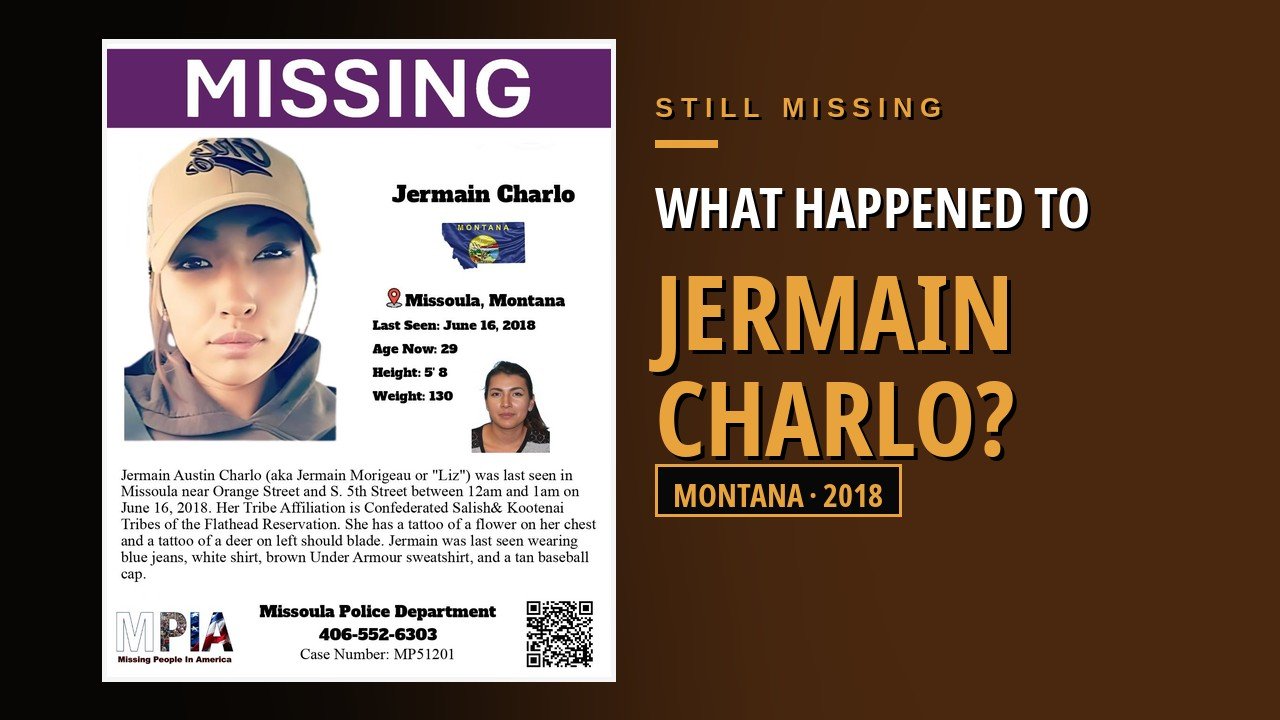
- Name: Jermain Austin Charlo (“Liz”)
- Age at disappearance: 23
- Last seen: June 16, 2018, ~midnight
- Location: Alley behind the Badlander bar, downtown Missoula, Montana
- Height / build: 5’9″, ~130 lbs, brown hair, brown eyes; flower tattoo on chest, deer tattoo on left shoulder blade
- Status: Still missing — investigated as a no-body homicide
- Investigating agency: Missoula Police Department
Out of frame
The last images of Jermain Charlo are timestamped just before midnight on June 16, 2018. A downtown Missoula surveillance camera watches an alley behind the Badlander bar. Jermain — 23, laughing with friends a few minutes earlier — walks east through the alley with her ex, Michael DeFrance, in step behind her. They walk out of frame.
That is the last confirmed sighting. She was never seen again.
The night had started like dozens before it. Jermain, an enrolled member of the Confederated Salish and Kootenai Tribes living on the Flathead Reservation, had gone out with DeFrance — the father of her two young sons, ages 2 and 4 — hitting three or four downtown bars: the Badlander, the Golden Rose, the Dark Horse. She had plans to stay at her new boyfriend Jacob’s apartment later that night. She had applied for a firefighting job with her tribe. People who knew her said she was optimistic, turning a page.
What happened between the alley and the morning has never been established. DeFrance later told investigators he dropped her off at an intersection and she walked toward a friend’s house. Her phone told a different story: cell-tower data placed it on Evaro Hill, near DeFrance’s family property, before it went permanently dark — eventually discarded in Idaho. DeFrance admitted disposing of her phone. He has never been charged in connection with her disappearance, and the presumption of innocence stands.
Who Jermain was
“Jermain was beautiful, vibrant and creative,” prosecutor Kelly Siegler said of her. “She liked to dress up and go out with her friends, but she also liked to go outdoors and go hiking and fishing and get dirty. She loved being a mom.”
Loved ones called her Liz. She was raising two small boys while working several jobs, navigating an on-again, off-again relationship with DeFrance that had been marked by his controlling behavior and two arrests for domestic violence against her — one in 2013 and earlier incidents. DeFrance had gained full custody of the children, a strain the family says complicated everything. By early 2018 she was seeing someone new and looking ahead: the firefighting application, the fresh start.
That night she wore jeans, square-toed cowboy boots, a white t-shirt, a gray hooded sweatshirt with a brown Under Armour logo, and a blue baseball cap decorated with three trees and a tan bill. Every detail has been repeated for years on posters, in documentaries, at vigils.
The investigation
Missoula police treated the case as a homicide early — a no-body homicide, with no remains ever recovered despite numerous searches across Missoula County and tribal land.
Detective Guy Baker, who has carried the case for years, laid out his three theories publicly in 2023: “One is the possibility that Jermain was sex trafficked; another relates to drug activity; and the third involves someone she previously had a relationship with.” No arrests have been made under any of them.
The digital evidence has been the backbone: the Badlander alley footage, the shifting accounts of where Jermain was dropped off (first outside the Orange Street Food Farm, later revised to eight blocks west to meet an unverified friend called Cassidy), and the phone’s journey to Evaro Hill and then Idaho. In August 2021, federal authorities detailed the cell-tower findings. DeFrance was convicted of unrelated federal firearm violations in 2023; the Ninth Circuit vacated that sentence in December 2024.
The case has become one of the most prominent in the national Missing and Murdered Indigenous Women crisis — the contrast between the resources deployed for Jermain and those famously deployed for Gabby Petito three years later has been widely cited. “Jermain’s case has been a rallying cry for bringing attention to the issue,” Siegler said. “It’s gone unsolved long enough.”
In October 2024, CBS’s 48 Hours aired “Where is Jermain Charlo?,” with an encore presentation in June 2025. In November 2025, Oxygen’s Cold Justice (Season 8, Episode 10, “Missing in Montana”) brought Siegler and investigator Steve Spingola to the seven-year-old mystery. And in 2026, a review team presented its findings to the Missoula County Attorney’s Office to discuss a possible homicide charge — a development her family met with relief and pain, and with a hope one relative described as finally returning after years of waiting by the phone. No charge has been filed.
Theories: what might have happened
Eight years, no body, no charge. The evidence grades the theories this way:
Killed by someone she knew. The theory investigators have pursued hardest. The points of pressure: the last-known-companion’s shifting drop-off story, the phone’s movement to his family’s property area, his admission that he disposed of the phone, and a documented history of domestic violence. What it lacks: a body, a witness to violence, forensic proof. It remains a theory — and DeFrance, never charged, is presumed innocent.
Sex trafficking. One of Detective Baker’s three theories. Jermain was a young Indigenous woman out late in a downtown bar district — a profile traffickers target. But there is no evidence she was taken by traffickers: no sightings, no communications, no pattern evidence. It remains an investigated possibility, not a supported conclusion.
Drug-related violence. The second Baker theory. Jermain’s circle included people adjacent to drug activity, and Missoula police have never ruled out that the night intersected with it. As with trafficking: no direct evidence has been made public.
Voluntary disappearance. There is essentially nothing for this. Jermain’s social media went silent that night and never resumed; she left her children, her new relationship, her job application, her entire life, without a word, without money, without a plan. Her family has never believed it, and investigators do not pursue it.
Have information?
Contact the Missoula Police Department — the Jermain Charlo case line is active (ask for Detective Guy Baker’s unit). In an emergency, dial 911.
Timeline
- June 15, 2018, evening — Jermain goes out with ex Michael DeFrance to downtown Missoula bars.
- June 16, 2018, ~midnight — Surveillance captures them walking east through the Badlander alley, out of frame. Last confirmed sighting.
- June 16, 2018 (later) — Her phone pings on Evaro Hill, then goes dark; it is later discarded in Idaho.
- 2018–2019 — Searches across Missoula County and tribal land find nothing. A fake Facebook page using her photos is ruled unrelated.
- August 2021 — Federal press release details the cell-tower evidence.
- 2023 — Det. Guy Baker publicly outlines three theories; DeFrance convicted of unrelated firearm violations.
- December 2024 — Ninth Circuit vacates the firearms sentence.
- October 2024 — 48 Hours: “Where is Jermain Charlo?” (original airdate; encore June 2025)
- November 2025 — Cold Justice: “Missing in Montana.”
- 2026 — Review team presents findings to the Missoula County Attorney’s Office regarding a possible homicide charge. No charge filed.
- Today — Still missing.
FAQ
Is Jermain Charlo still missing?
Yes. As of October 2026, Jermain Charlo has been missing for more than eight years. No remains have ever been found, and no one has been charged in her disappearance.
What happened to Jermain Charlo?
She was last seen on surveillance video walking through an alley behind the Badlander bar in downtown Missoula around midnight on June 16, 2018, with her ex-partner Michael DeFrance. Her phone later pinged near his family’s property before going dark. Authorities investigate the case as a homicide.
Was anyone arrested in the Jermain Charlo case?
No one has been arrested or charged in connection with her disappearance. DeFrance was convicted of unrelated federal firearm violations in 2023, but that sentence was vacated in 2024.
What did the Cold Justice episode reveal?
The November 2025 episode “Missing in Montana” re-examined the surveillance footage, the shifting drop-off accounts, and the phone evidence. It did not produce an arrest, but renewed national attention.
How old would Jermain Charlo be today?
Jermain was 23 when she disappeared in June 2018 — she would be 31 in 2026.
How can I help?
Share this case file. Anyone with information should contact the Missoula Police Department’s Jermain Charlo case line.
Sources
- Official / law enforcement: Missoula Police Department (Det. Guy Baker statements); U.S. Department of Justice press release (Aug 2, 2021).
- News: CBS News / 48 Hours, “Where is Jermain Charlo?” (original airdate October 2024; encore June 2025); NBC Montana (Jan 2025); KPAX; The Missoulian.
- Reference: The Charley Project, “Jermain Austin Charlo.”
- Media: Oxygen Cold Justice, Season 8, Episode 10, “Missing in Montana” (Nov 15, 2025); Oxygen, “Indigenous Montana Mom Jermain Charlo Vanished After Night Out With Ex-Boyfriend”; True Case Files, “The Disappearance of Jermain Charlo” (2020).
Correction (Oct 2026 verification): “In June 2025, CBS’s 48 Hours aired ‘Where is Jermain Charlo?'” → “In October 2024, CBS’s 48 Hours aired ‘Where is Jermain Charlo?,’ with an encore presentation in June 2025” (Paramount press release, Oct 10, 2024, announcing the Oct 12 broadcast; sportskeeda coverage of the June 7, 2025 encore). Note: one low-quality source claims Michael DeFrance was indicted in a no-body homicide case — this contradicts all authoritative reporting (CBS/Oxygen/Justice.gov), which states he has not been charged in connection with her disappearance; the file’s “no arrests” statement is correct. Found an error? Tell us via the About page and we will fix it promptly and note the change here. Last verified October 2026.