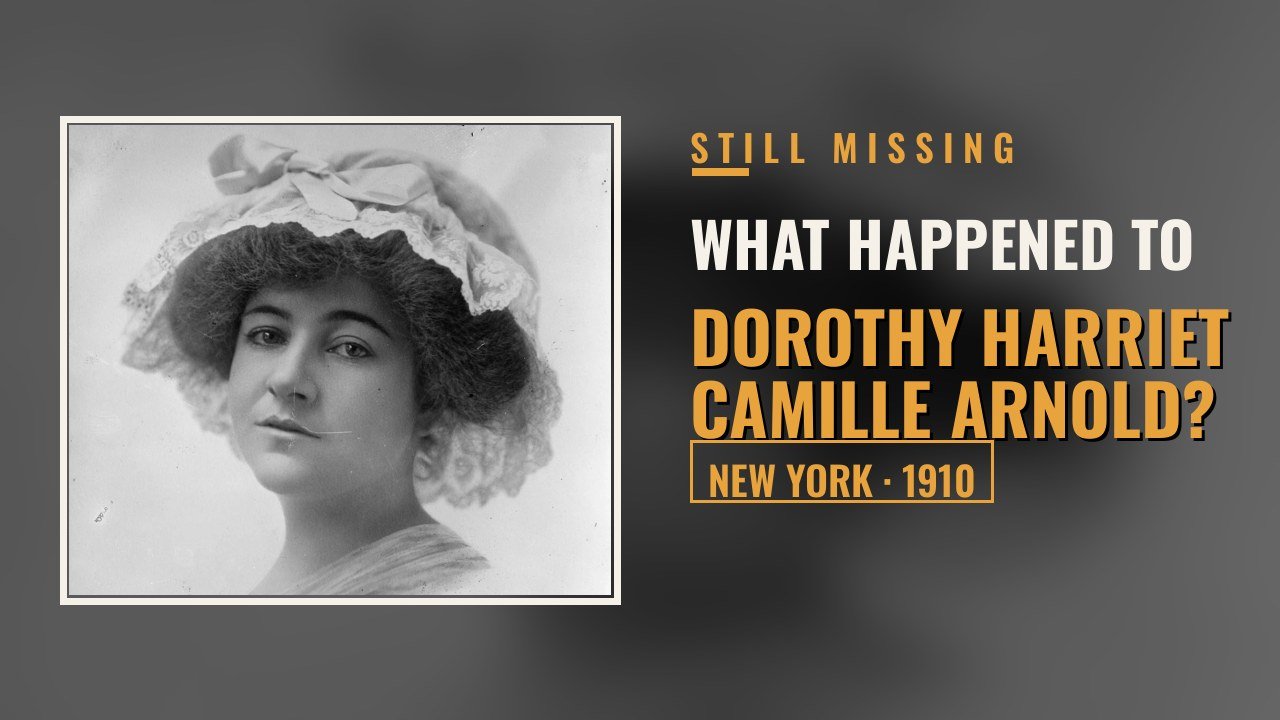
Key facts
- Name: Dorothy Harriet Camille Arnold
- Born: July 1, 1885, New York City
- Age at disappearance: 25
- Last seen: December 12, 1910, shortly before 2:00 p.m.
- Location: Fifth Avenue at 27th Street, Manhattan, New York City
- Height / build: 5’4″, ~140 lbs, dark brown hair, blue-gray eyes
- Status: Still missing — declared dead in absentia; fate unknown
- Investigating agency: New York Police Department (historical case)
The wave goodbye
Shortly before 2 p.m. on December 12, 1910, Dorothy Arnold ran into her friend Gladys King outside Brentano’s bookstore at Fifth Avenue and 27th Street. They chatted briefly — about Dorothy’s younger sister Marjorie’s upcoming debutante party. Dorothy seemed to be in good spirits.
She told Gladys she was going to walk home through Central Park.
Gladys turned to leave for lunch at the Waldorf-Astoria. Dorothy walked away, turned, and waved. Then she turned and waved a second time, looking back.
That was the last time anyone ever saw Dorothy Arnold.
She’d left home at 11 that morning to shop for a dress for Marjorie’s party. She’d stopped at the Park & Tilford candy store at Fifth and 59th, charged a half-pound of chocolates to her account, tucked the box in her muff. She’d walked 32 blocks south to Brentano’s and bought Engaged Girl Sketches, a book of humorous essays. The clerks at both stores said she was courteous, unremarkable, behaving completely normally.
She never came home for dinner. She had about $25–30 in cash — roughly $900 today. She was wearing a navy-blue serge suit, tan gloves, a black fox fur muff, a black velvet hat over a pompadour, a lover’s knot ring, lapis lazuli earrings. She took nothing else. Every other thing she owned was found in her bedroom, accounted for.
Who Dorothy was
Dorothy Harriet Camille Arnold was born into the kind of Manhattan wealth that gets listed in the Social Register. Her father, Francis R. Arnold, was a Harvard man, senior partner of F.R. Arnold & Co., importers of fancy goods — perfumes. The family lived at 108 East 79th Street. Her aunt was married to a U.S. Supreme Court justice. Her father’s family had come over on the Mayflower.
Dorothy went to the Veltin School for Girls and Bryn Mawr College, where she majored in literature and language, graduating in 1905. Then she tried to become a writer — and the world said no. In the spring of 1910, McClure’s magazine rejected her short story. Friends teased her about it. She rented a post office box so rejections wouldn’t come to the house. In November 1910 she submitted another story, “The Poinsettia Flames.” Rejected again. Friends said the second rejection left her dejected and embarrassed.
Two months before she vanished, she asked her father if she could take an apartment in Greenwich Village to write. He refused: “A good writer can write anywhere.”
There was also a man. George Griscom Jr., a 40-year-old engineer from a wealthy Pennsylvania family, whom Dorothy had met through Bryn Mawr circles. In September 1910 she’d lied to her parents about visiting a classmate in Boston and spent a week in a hotel with Griscom instead — financing it by pawning $500 in jewels. When her parents found out, they forbade the relationship. She kept writing to him anyway. They saw each other for the last time in early November, before he left on vacation with his parents.
The six weeks of silence
Here is the part of the story that still stuns: the Arnold family didn’t call the police.
Terrified of publicity — of the social ruin that had engulfed another prominent family the year before when 13-year-old Adele Boas ran away to Boston and the papers feasted on it — Francis Arnold hired private help instead. The morning after Dorothy vanished, the family lawyer, John S. Keith, searched her bedroom. He found the burned remains of manuscripts in her fireplace, personal letters with foreign postmarks, and two folders for transatlantic ocean liners on her desk.
Keith checked jails, hospitals, and morgues in New York, Boston, and Philadelphia. Nothing. Then he brought in the Pinkertons.
The Pinkerton theory: she’d eloped to Europe with a man. They searched marriage records. They sent agents to meet ocean liners. They found several women who looked like Dorothy. None of them was Dorothy.
Six weeks. That’s how long the family of one of the most famous missing women in American history kept her disappearance from the police.
On January 25, 1911, Francis Arnold finally held a press conference and offered a $1,000 reward — about $35,000 today. The Times covered the story nearly daily. Tips poured in from across the country. Two ransom notes arrived; both were hoaxes.
Griscom was tracked to Florence, Italy, vacationing with his parents. The Arnolds cabled him on December 16. He denied knowing anything. In January, Dorothy’s mother and brother sailed to Italy and confronted him in his room at the Anglo-American Hotel. He maintained he knew nothing. Her brother demanded Dorothy’s letters to Griscom, then destroyed them — he said they contained nothing important. Back in the States, Griscom told the press he intended to marry Dorothy once she was found, if her mother approved. Her mother said she never would.
Theories: what might have happened
Killed walking through Central Park. Francis Arnold’s own theory: attacked on her walk home, body thrown in the Central Park Reservoir. He claimed two undisclosed clues confirmed it. Police dismissed it — the reservoir had frozen solid in 21°F weather — but searched the park anyway, then the water when it thawed. Nothing.
Suicide. She’d been rejected twice, forbidden her independence, forbidden her lover. Friends said she’d made allusions to suicide. But no body was ever recovered from the rivers or the harbor, and the “good spirits” Gladys King saw cut against it — though despair doesn’t always show.
A botched abortion. The darkest theory, and a persistent one: pregnant by Griscom, desperate, she died at the hands of an illegal abortionist. It would explain the secrecy, the burned papers, the family’s terror of publicity. It is entirely unproven — no doctor, no clinic, no witness ever surfaced.
Voluntary disappearance — a new life. The ocean liner folders. The post office box. The foreign-postmarked letters. In February 1911, Francis received a postcard signed “Dorothy,” postmarked New York City: “I am safe.” The handwriting matched — but her writing had been splashed across every newspaper in America, and Francis called it a cruel joke. A San Francisco jeweler claimed a woman he took for Dorothy had him engrave a wedding ring on January 7: “To A.J.A. from E.R.B., December 10, 1910.” None of it was ever verified.
Amnesia. She slipped on the ice, hit her head, wandered into a hospital unknown. Police checked. No matching patients.
By the end of January 1911, Deputy Police Commissioner William J. Flynn said it out loud: “That now seems the only reasonable way of looking at the case. The girl has now been missing for 75 days and in all that time not a single clue has been found that was worth the name.” Her mother never accepted it. To her dying day, she believed Dorothy was alive.
Have information?
This is a historical case, but tips can still be directed to NYPD Crime Stoppers at 1-800-577-TIPS. In an emergency, dial 911.
Timeline
- July 1, 1885 — Dorothy Harriet Camille Arnold is born in New York City.
- 1905 — Graduates from Bryn Mawr College; attempts a writing career.
- Spring 1910 — McClure’s rejects her first story; she rents a P.O. box for correspondence.
- September 1910 — Secret week in a Boston hotel with George Griscom Jr.; parents discover it, forbid the relationship.
- November 1910 — McClure’s rejects “The Poinsettia Flames”; last meeting with Griscom.
- ~October 1910 — Asks to move to Greenwich Village to write; her father refuses.
- December 12, 1910, 11:00 a.m. — Leaves 108 East 79th Street to shop for a dress.
- December 12, 1910, ~12:00 p.m. — Buys chocolates at Park & Tilford, Fifth and 59th.
- December 12, 1910, early afternoon — Buys Engaged Girl Sketches at Brentano’s, Fifth and 27th.
- December 12, 1910, shortly before 2:00 p.m. — Meets Gladys King outside Brentano’s; waves goodbye twice. Last confirmed sighting.
- December 12, 1910, evening — Fails to appear for dinner; family begins calling friends.
- December 13, 1910 — Family lawyer searches her room; finds burned manuscripts, ocean liner folders.
- December 1910 – January 1911 — Pinkerton investigation; elopement-to-Europe theory; nothing found.
- January 25, 1911 — Francis Arnold holds a press conference; $1,000 reward; NYPD takes the case.
- February 1911 — “I am safe” postcard arrives; Francis calls it a hoax. NYPD scales back, believing her dead.
- 1911–1920s — Sightings and rumors continue for decades; none verified.
- Today — Still missing; fate unknown after 115 years.
FAQ
Is Dorothy Arnold still missing?
Yes. Dorothy Arnold vanished on December 12, 1910, and no trace of her has ever been found. She was eventually declared dead in absentia, but her fate remains unknown 115 years later.
What happened to Dorothy Arnold?
Nobody knows. Theories include murder in Central Park, suicide after professional and romantic despair, death during an illegal abortion, and voluntary disappearance to start a new life. None has ever been proven.
Who was George Griscom Jr.?
A 40-year-old engineer from a wealthy Pennsylvania family with whom the 25-year-old Dorothy had a secret romance. Her parents forbade the relationship after discovering a week-long hotel rendezvous. He was in Italy when she vanished, denied any knowledge, and was never charged.
Why didn’t Dorothy Arnold’s family call the police right away?
They feared the social scandal of publicity — another prominent family had been humiliated in the press the year before over a runaway daughter. They hired private investigators and the Pinkertons first, waiting six weeks before going to the NYPD in January 1911.
Was Dorothy Arnold ever found?
No. Despite one of the most publicized missing-person investigations of the early 20th century, no confirmed trace of her was ever discovered.
Sources
- Official / law enforcement: NYPD (historical investigation, 1911); Pinkerton National Detective Agency reports (via contemporary press).
- News: The New York Times (1910–1911, near-daily coverage); San Francisco Chronicle (Feb 1911); Untapped New York (Dec 2016 retrospective).
- Reference: Wikipedia, “Disappearance of Dorothy Arnold” (retrieved Oct 2026).
Found an error? Tell us via the About page and we will fix it promptly and note the change here. Last verified October 2026.