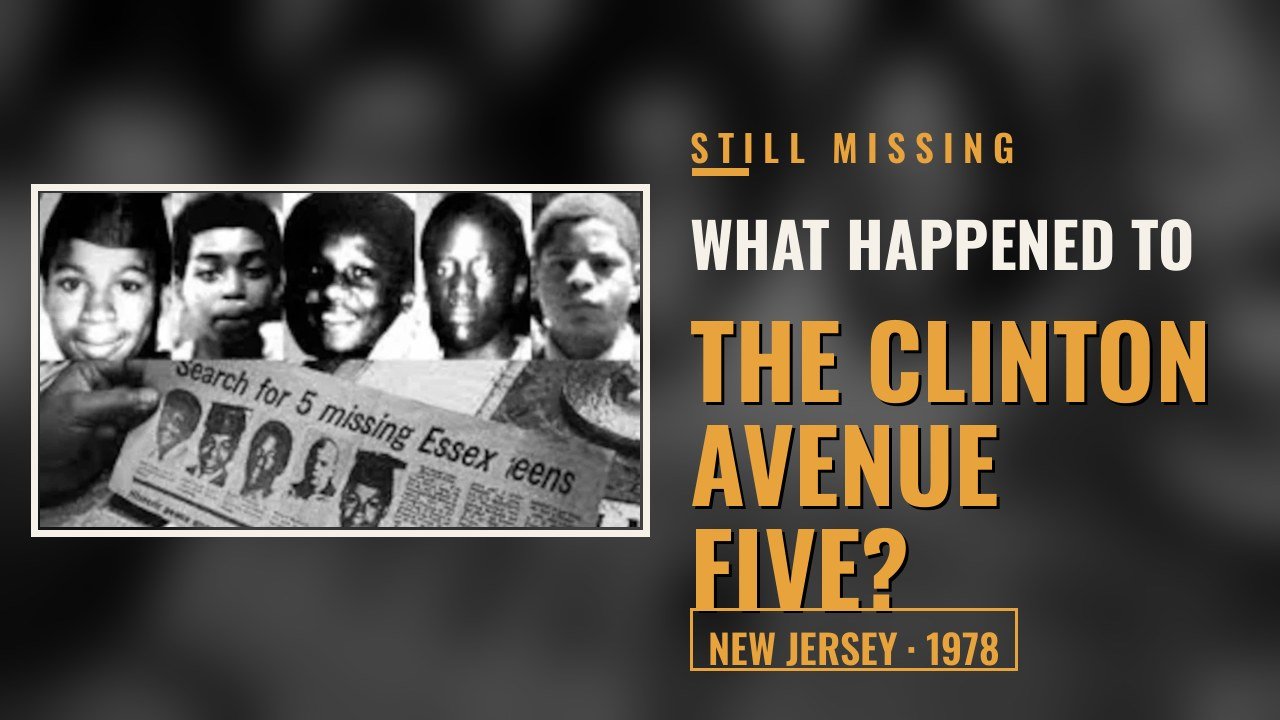
Key facts
- Names: Melvin “Ricky” Pittman (17), Ernest Taylor (17), Alvin Turner (16), Randy Johnson (16), Michael McDowell (16)
- Last seen: August 20, 1978
- Location: Clinton Avenue and Fabian Place, Newark, New Jersey
- Status: Still missing — remains never recovered; no one is convicted in the deaths
- Investigating agency: Newark Police Department; Essex County Prosecutor’s Office
Five boys on a corner
On the evening of August 20, 1978, five teenagers from Newark were last seen together on a busy street near a park where they had been playing basketball — the corner of Clinton Avenue and Fabian Place. Melvin “Ricky” Pittman and Ernest Taylor were 17. Alvin Turner, Randy Johnson, and Michael McDowell were 16.
Their families reported them missing the next day. Nobody has ever seen them again.
There was a fire that night too — a house burned at what investigators would later identify as 256 Camden Street, not far from where the boys vanished. It would take 32 years for anyone to connect the fire to the boys. And even now, with a confession, an arrest, a trial, an acquittal, a plea deal, and a federal civil-rights lawsuit, the most important fact has never changed: the remains of the five boys have never been found.
The case that went cold for 32 years
The initial investigation went nowhere. A local contractor, Lee Anthony Evans, who routinely hired neighborhood teenagers for odd jobs, was the last person known to have seen the boys — he told police he’d dropped them off on a street corner near an ice cream parlor. Later that night, Michael McDowell returned home and changed his clothes, then got back into a waiting pickup truck with at least one other boy inside. That was the last confirmed sighting of any of the five.
Evans was interviewed repeatedly in the months after the disappearances. He passed a lie detector test and was cleared. The case went cold, and stayed cold, for three decades.
The confession
In November 2008, Philander Hampton — a 53-year-old carpenter, Evans’s cousin — was in police custody on an unrelated charge. After what he later said was a 13-hour interrogation, Hampton confessed to involvement in murdering the boys. His account, as prosecutors later presented it: he and Evans lured the five teenagers to Hampton’s former Newark residence at 256 Camden Street with the promise of employment. Angry that the boys had stolen marijuana from his home, Evans had Hampton hold two of them at gunpoint while Evans rounded up the other three. The boys were led to a third-floor bedroom closet at gunpoint and locked in. Evans then set the house on fire with five gallons of gasoline, and all five boys perished.
Hampton led investigators to the fire site. Authorities searched the grounds with sonar equipment. No human remains were found.
In March 2010, Evans and Hampton were arrested and charged with felony murder and arson, each held on $5 million bail. The boys had been gone 32 years.
The trials — and the acquittal
Here the case fractured. Hampton pleaded guilty in August 2011 and received a 10-year sentence in exchange for testifying against Evans. He was released on February 27, 2017.
Lee Anthony Evans went to trial — and in November 2011, representing himself with the help of a legal advisor, was acquitted on all five counts of felony murder. The defense unraveled Hampton’s testimony: his extensive criminal history, the plea deal, the 13-hour interrogation that produced the confession. There were no bodies, no DNA, no forensic evidence linking anyone to the crime — only Hampton’s word.
Evans, 58 at the time, said the verdict didn’t erase the accusation: “That was the jury, that wasn’t the people. That’s not the same thing as someone destroying you. It’s like someone put you in the oven and burned you up. You can’t undo that.”
The legal story isn’t over. Evans filed a civil-rights lawsuit alleging malicious prosecution, and in September 2025 a three-judge panel of the Third Circuit Court of Appeals ruled that two detectives’ qualified immunity did not cover “coercive confessions and fabricated evidence” — allowing his suit against them to proceed.
Theories: what might have happened
Forty-eight years. No remains. A confession, a plea, an acquittal. Each theory carries the weight of what the courts did and didn’t establish.
They were killed in the house fire, as Hampton described. The evidence for it: Hampton’s detailed confession, his guilty plea, the guilty plea being an admission against his own interest. The evidence against it: no remains were ever found at the fire site despite sonar searches; Hampton said he confessed after 13 hours of questioning; the sole corroborating witness’s testimony was dismantled at Evans’s trial; and a jury acquitted Evans of all five murders. A confession without a body, and a conviction only for the man who confessed.
The confession was false. Evans’s position, upheld by a jury and now being tested in his civil suit: that Hampton’s confession was coerced and the evidence fabricated. The 13-hour interrogation, the plea deal, the absence of any forensic corroboration — these are the pillars of the argument. If true, the boys’ fate is as unknown as it was in 1978.
Something else entirely. That neither Hampton’s account nor Evans’s vindication captures what happened — that the truth about that August night is still out there, buried with five boys whose families have waited 48 years. The remains, wherever they are, are the only witnesses left.
Have information?
Contact the Newark Police Department or the Essex County Prosecutor’s Office. In an emergency, dial 911.
Timeline
- August 20, 1978 — The five teenagers are last seen on Clinton Avenue and Fabian Place, Newark; three buildings burn nearby that night.
- August 21, 1978 — Families report the boys missing.
- 1978–1979 — Lee Anthony Evans interviewed repeatedly, passes a lie detector, is cleared. Case goes cold.
- November 2008 — Philander Hampton confesses after a 13-hour interrogation; sonar search of the fire site finds no remains.
- March 22, 2010 — Evans and Hampton arrested, charged with felony murder and arson.
- August 2011 — Hampton pleads guilty; sentenced to 10 years.
- November 2011 — Evans acquitted on all five counts of felony murder.
- February 27, 2017 — Hampton released.
- September 2025 — Third Circuit rules Evans’s malicious-prosecution suit against two detectives may proceed.
- Today — Still missing. No remains have ever been found.
FAQ
Are the Clinton Avenue Five still missing?
Yes. Melvin Pittman, Ernest Taylor, Alvin Turner, Randy Johnson, and Michael McDowell have been missing since August 20, 1978. Their remains have never been found.
What happened to the Clinton Avenue Five?
That is genuinely disputed. Philander Hampton confessed in 2008 that he and his cousin killed the boys in a house fire; he pleaded guilty. But no remains were ever found, and Lee Anthony Evans — whom Hampton implicated — was acquitted of all murder charges in 2011. The boys’ fate has never been forensically established.
Was anyone convicted of killing the Clinton Avenue Five?
Philander Hampton pleaded guilty in 2011 and served a 10-year sentence. Lee Anthony Evans, his cousin, was acquitted of all five murder counts in November 2011. No one is currently convicted in the deaths.
Who were the Clinton Avenue Five?
Melvin “Ricky” Pittman (17), Ernest Taylor (17), Alvin Turner (16), Randy Johnson (16), and Michael McDowell (16) — five teenagers from Newark, New Jersey, last seen on Clinton Avenue on August 20, 1978.
How can I help?
Share this case file. Anyone with information should contact the Newark Police Department or the Essex County Prosecutor’s Office.
Sources
- Official / law enforcement: Newark Police Department; Essex County Prosecutor’s Office; U.S. District Court, D.N.J., Evans v. City of Newark, Civ. 14-00120; U.S. Court of Appeals for the Third Circuit (Sept. 12, 2025 ruling).
- News: The Christian Post, “Lee Evans ‘Not Guilty’ of Murdering 5 Newark Teens” (Nov 23, 2011); Law Officer, “Murder Charges Announced in ’78 Case of 5 NJ Teens” (Mar 2010); Local Talk Weekly, “Federal Judges: Detectives’ Immunity Lifted in Clinton Avenue Five Case” (Sept 26, 2025).
- Reference: Wikipedia, “Clinton Avenue Five” (retrieved Oct 2026).
Found an error? Tell us via the About page and we will fix it promptly and note the change here. Last verified October 2026.
Corrections (Oct 2026): Softened the opening-paragraph claim that “three buildings burned” the night of the disappearance — the number and exact proximity could not be verified; the sourced record identifies the fire site as the house at 256 Camden Street (Wikipedia; Hampton confession account).