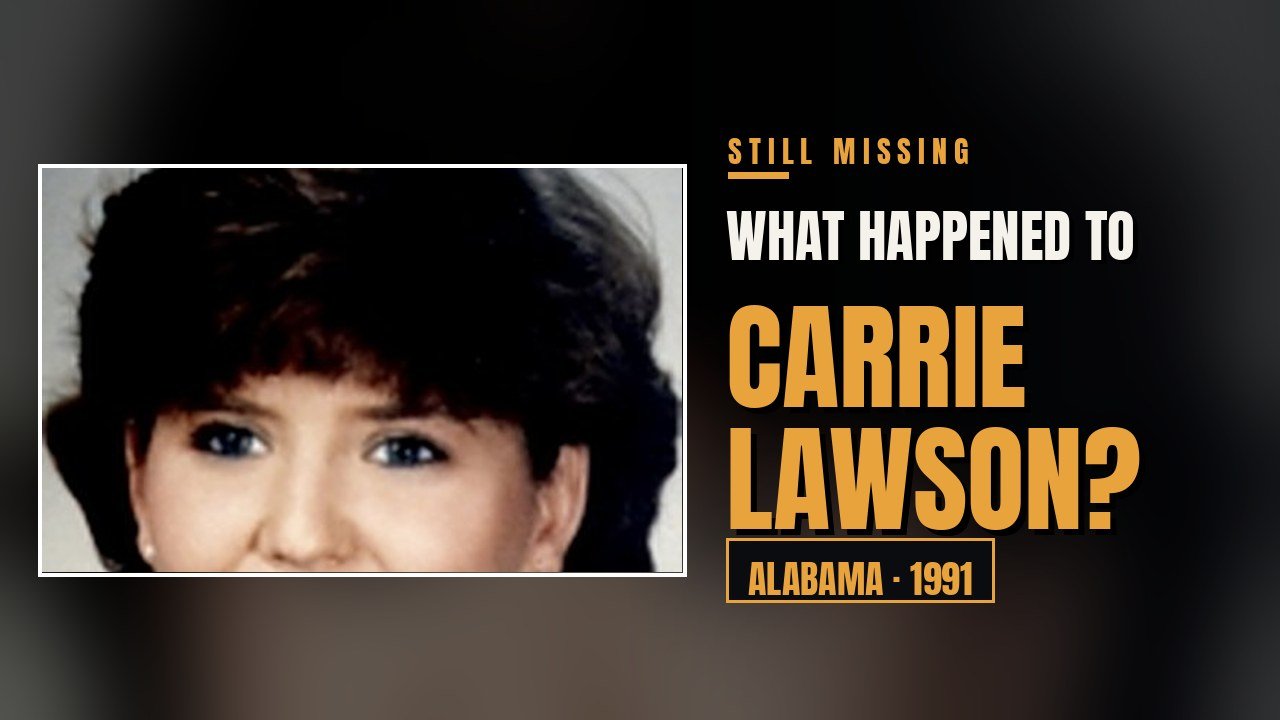
Key facts
- Name: Carolyn “Carrie” Lawson (née Smith)
- Born: Alabama (exact date not publicly confirmed)
- Age at disappearance: 25
- Last seen: September 11, 1991, around 3:00 a.m.
- Location: Her home in Jasper, Alabama — abducted from her carport
- Height / build: Approximately 5’6″; details of clothing that night not publicly confirmed
- Status: Still missing — kidnapping; ransom was demanded and paid, but Carrie was never returned
- Case numbers: Not publicly confirmed
- Investigating agency: Federal Bureau of Investigation; Walker County Sheriff’s Office
The phone call
It came at 3 a.m.
On September 11, 1991, in the small town of Jasper, Alabama, Earl and Carrie Lawson were asleep when the phone rang. A woman on the line said she was a nurse at the local hospital. A close family member was there, she said, and might not make it through the night. They needed to come right away.
Earl’s father had recently been ill. The couple believed her.
They threw on clothes and rushed out to their Ford Explorer in the carport. That’s when the masked man stepped out with a gun.
He forced Earl to the ground. Then he made Carrie do the rest — bind her own husband with duct tape. Earl watched, helpless, as the gunman forced 25-year-old Carrie into the Explorer and raced off into the darkness. Earl managed to break free, kicked in his back door, and called for help.
Within hours, the family received a ransom demand: $300,000 for Carrie’s safe return. The family was willing to pay. The money was paid.
Carrie Lawson never came home.
Who Carrie was
Carrie Lawson had just built the life she had worked for years to earn. Twenty-five years old, newly married to Earl, a recent graduate of the University of Alabama School of Law, newly admitted to the bar. She and Earl were settling into their first home in Jasper.
Her sister, Margaret Smith Kubiszyn, has spent the decades since keeping Carrie’s name in front of the public — sitting for podcast interviews, supporting a documentary effort, and insisting that the full story of what happened to her sister has never been told.
The investigation — and the mistakes
The FBI took the lead, and by many accounts, the ransom operation went badly. The Southern Fried True Crime podcast’s two-part investigation (episodes 218–219) walks through what it describes as a parade of mistakes in the FBI’s handling of the case — decisions made in the frantic hours after the abduction that may have cost Carrie her life.
The man investigators identified as the gunman was Jerry Bland. On October 2, 1991 — less than a month after the kidnapping — The New York Times ran the headline: “Kidnapped woman still missing as suspect is an apparent suicide.” Bland was dead, and Carrie was still gone.
Bland’s cousin, Karen McPherson, was convicted in connection with the kidnapping and sentenced to prison. She has maintained, through the decades, that she knows nothing about where Carrie is. Southern Gone host Kristi Bryant, who has investigated the case across multiple episodes, has said she believes more people were involved than McPherson alone.
Ten days after the abduction, on September 21, searchers found the Lawsons’ Ford Explorer in the Bankhead National Forest near Black Pond in Winston County — dense Alabama woods, in the middle of dove hunting season, exactly the kind of place to dump an unwanted vehicle. Authorities examined it thoroughly. Nothing significant was reported found.
The reward for information leading to Carrie’s whereabouts was raised from $100,000 to $400,000 — close to a million dollars in today’s money — funded by donations from Carrie’s friends and family across Alabama and Tennessee. Thousands of missing-person flyers went out. Carrie’s church organized and fed search parties. Her law school classmates searched.
One strange lead surfaced weeks later: a gas station employee at the Northwood Lake Chevron near Tuscaloosa — about 60 miles south of Jasper — told the Birmingham Post-Herald that FBI agents had asked about the pay phone outside his store, and that Carrie had allegedly used it to call someone at 3:15 a.m. on September 12, nearly 24 hours after she was taken. If true, it meant Carrie was alive a full day after the abduction — and that someone let her near a phone. The claim was reported by journalists; it was never officially confirmed.
Theories: what might have happened
Carrie was killed during or shortly after the ransom exchange. This is the outcome investigators have long presumed. The ransom was paid, she was never returned, and the man identified as the gunman died by suicide within weeks. What supports it: the standard pattern of ransom kidnappings gone wrong, and 35 years of silence. What undercuts it: no body, no confirmed kill site, and the persistent questions about whether Bland acted alone.
Others were involved — and one of them is still free. Kristi Bryant’s Southern Gone investigation argues that Karen McPherson could not have been the only person involved in Carrie’s disappearance, and the podcast has pressed for a re-examination of the case with that in mind. What supports it: the complexity of the abduction — the fake nurse call, the timing, the ransom logistics — suggests planning beyond a single gunman. What is unproven: no additional person has ever been charged.
Carrie survived the initial abduction. The alleged 3:15 a.m. pay-phone call on September 12 keeps this theory alive. If Carrie reached a phone a day after she was taken, the window in which she might have been rescued was real — and it closed. Treat this as reported, not confirmed: it rests on a single gas station employee’s account to a newspaper, not on an official finding.
A note on presumption: Karen McPherson was convicted of kidnapping in connection with this case. Jerry Bland is deceased. No one else has been charged.
Have information?
Contact the FBI at 1-800-CALL-FBI (1-800-225-5324) or submit a tip at tips.fbi.gov. You can also contact the National Center for Missing & Exploited Children at 1-800-843-5678. In an emergency, dial 911.
Timeline
- 1991 — Carrie Lawson, 25, graduates from the University of Alabama School of Law and is admitted to the bar; marries Earl Lawson; the couple settles in Jasper.
- September 11, 1991, ~3:00 a.m. — A fake “nurse” phone call lures the Lawsons from their home; a masked gunman abducts Carrie from the carport in the couple’s Ford Explorer.
- September 11, 1991 (hours later) — Ransom demand of $300,000 received; the family agrees to pay.
- September 12, 1991, 3:15 a.m. (reported, unconfirmed) — Carrie allegedly uses a pay phone outside a Chevron near Tuscaloosa, ~24 hours after the abduction.
- September 21, 1991 — The Lawsons’ Ford Explorer is found abandoned in the Bankhead National Forest near Black Pond, Winston County. No significant evidence recovered.
- October 2, 1991 — The New York Times reports the suspect, Jerry Bland, is dead in an apparent suicide. Carrie is still missing.
- 1992 — Karen McPherson, Bland’s cousin, is convicted in connection with the kidnapping and sentenced to prison.
- 2016 — On the 25th anniversary, AL.com revisits the case: “Carrie Lawson disappeared 25 years ago.”
- 2019–2024 — The Southern Gone podcast (Kristi Bryant) airs a multi-part investigation; Southern Fried True Crime covers the case in episodes 218–219; She Goes by Jane profiles Carrie.
- Today — Still missing. A documentary, Justice for Carrie, is in production.
FAQ
Is Carrie Lawson still missing?
Yes. As of October 2026, Carrie Lawson has been missing for 35 years. She was kidnapped from her Jasper, Alabama home on September 11, 1991, and has never been found.
Was the ransom paid in the Carrie Lawson case?
Yes. The family received a $300,000 ransom demand within hours of the abduction and paid it — but Carrie was never returned.
Who kidnapped Carrie Lawson?
Jerry Bland was identified by investigators as the masked gunman. He died in an apparent suicide less than a month after the kidnapping. His cousin, Karen McPherson, was convicted in connection with the kidnapping. Podcast investigators have argued others may have been involved, but no one else has been charged.
Was Carrie Lawson ever found?
No. Neither Carrie nor her remains have ever been located. Her SUV was found ten days after the abduction in the Bankhead National Forest, but it yielded no significant evidence.
How can I help?
Share this case file. Anyone with information can contact the FBI at 1-800-CALL-FBI or NCMEC at 1-800-843-5678. Carrie’s sister supports the documentary effort at gofundme.com/carrielawson.
Sources
- Official / law enforcement: FBI (tips.fbi.gov, 1-800-CALL-FBI); Walker County Sheriff’s Office.
- News: The New York Times, “Kidnapped woman still missing as suspect is an apparent suicide” (Oct 2, 1991); AL.com, “Carrie Lawson disappeared 25 years ago” (Sept 2016); Birmingham Post-Herald (pay-phone lead, via Southern Fried True Crime).
- Reference: SouthernGone.com; NamUs.
- Media: Southern Gone podcast (Kristi Bryant), episodes 9, 23+; Southern Fried True Crime, episodes 218–219 (Erica Kelley); She Goes by Jane, “The Unsolved Kidnapping of Carrie Lawson”; Justice for Carrie documentary (in production).
Found an error? Tell us via the About page and we will fix it promptly and note the change here. Last verified October 2026.