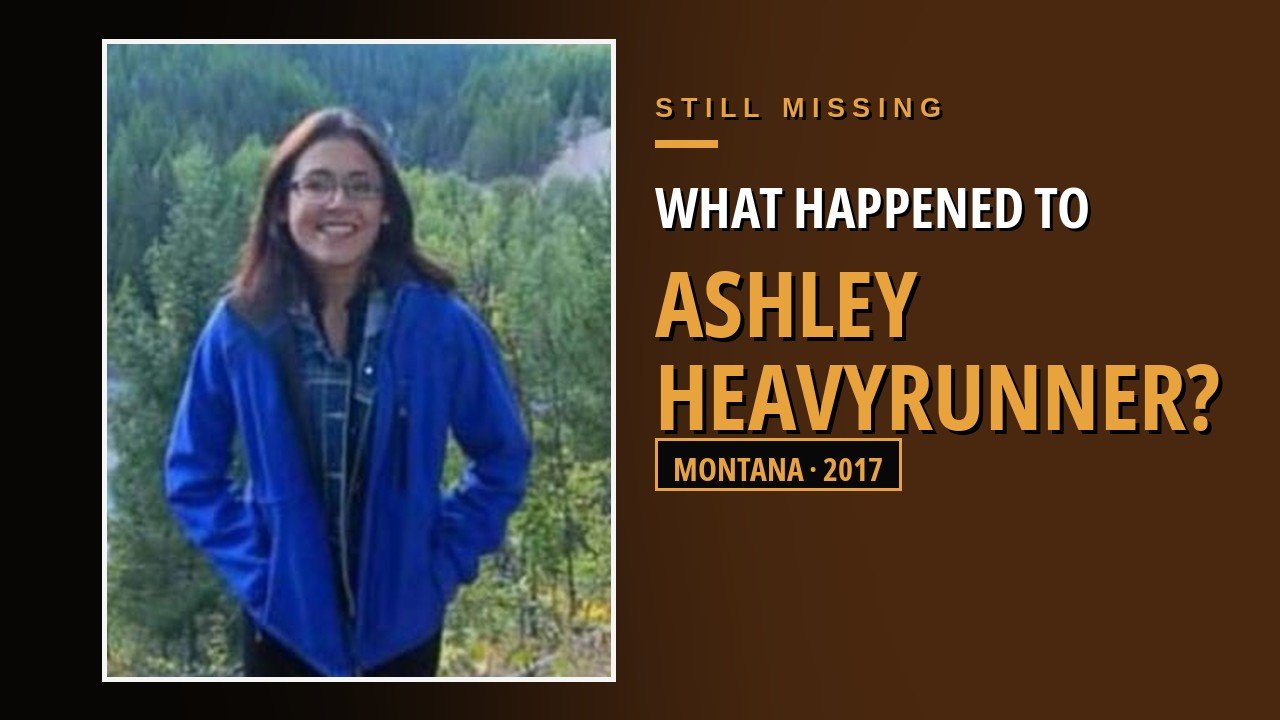
Key facts
- Name: Ashley Mariah Loring Heavyrunner
- Born: November 23, 1996, Browning, Montana
- Age at disappearance: 20
- Last seen: Early June 2017
- Location: Browning, Blackfeet Indian Reservation, Montana
- Height / build: 5’2″, ~90 lbs, dark hair; distinctive checkmark-shaped scar on her hand
- Status: Still missing — open investigation
- Investigating agency: FBI; Bureau of Indian Affairs Office of Justice Services, Missing and Murdered Unit
The party video
The last confirmed evidence of Ashley Loring Heavyrunner is a video recorded at a party in Browning, Montana, in early June 2017. After that night, accounts of her movements become uncertain and sometimes contradictory. Some people claimed to have seen or communicated with her in the days that followed. None of those reports has been publicly verified with the same certainty as the party video.
Then: nothing. No remains. No confirmed sightings. No charges. No established account of whether she was abducted, killed, injured, or taken somewhere against her will.
Her older sister, Kimberly Loring Heavyrunner, had been away on a trip. The plan had been set before she left: Ashley would leave the reservation and start fresh, living with Kimberly in Missoula, continuing her environmental science studies at Blackfeet Community College, building a future connected to her community and her ambitions. When Kimberly returned, the family hadn’t heard from Ashley. The plans faded into a search that has now lasted nine years.
In May 2025, speaking to NBC Montana, Kimberly revealed something the family had found too painful to say before: Ashley was pregnant when she vanished.
Who Ashley was
“Funny, smart and at times feisty” — that’s how Kimberly described her younger sister. Ashley Mariah Loring Heavyrunner was 20, a member of the Blackfeet Nation, an intelligent and ambitious college student with plans that extended well beyond the summer she disappeared. She was preparing for school, planning the move to Missoula, looking toward a future in environmental science while staying rooted in her community.
She was small — 5’2″, about 90 pounds — with dark hair and a checkmark-shaped scar on her hand that appears on every missing-persons poster. Her favorite color was purple; her mother has placed purple balloons around Browning in her honor for years.
The investigation
From the beginning, the family struggled to get law enforcement’s sustained attention — an experience now recognized as systemic in Missing and Murdered Indigenous Women cases. “From the beginning we had a hard time getting in contact with the law enforcement,” Kimberly told NBC Montana. “We spoke to them during the first search, and then after a while we weren’t able to contact them.” She has said she trusts God more than law enforcement.
The jurisdictional maze is part of the story: tribal police lack criminal jurisdiction in ways that have delayed and fragmented investigations across Indian Country, with overlapping federal authorities and chronic underfunding. Former U.S. Senator Heidi Heitkamp has cited cases like Ashley’s in describing how the lack of deterrence and prosecution increases Indigenous communities’ vulnerability to outsider violence.
What is publicly known of the investigation: reported sightings across the country that never panned out; clothing discovered in a field; years of tips. The Bureau of Indian Affairs posted an initial $1,000 reward in 2017, raised it to $10,000 by March 2018 and $15,000 by April 2019, with the Blackfeet Tribal Business Council contributing. A man named Sam Valenzuela was questioned in 2021 and denied knowledge of Ashley’s whereabouts. As of 2026, police have not named suspects or pursued arrests. The BIA has said recent tips were followed up but “did not result in any new information.”
In 2025, the family announced they would commit to one more search before they “leave it in God’s hands.” In 2026, the Montana Department of Justice featured Ashley in a statewide PSA spotlighting four Indigenous people still missing in Montana.
A movement’s case
Ashley’s disappearance has become one of the most prominent cases of the national Missing and Murdered Indigenous Women movement. The coverage has been high-profile — ABC News, The Guardian (“A young woman vanishes. The police can’t help. Her desperate family won’t give up,” 2019) — and the case has been used to contrast the media attention given to missing Indigenous women with that given to cases like Gabby Petito’s.
The people around her have turned grief into infrastructure. Annita Lucchesi, a former professor of Ashley’s at Blackfeet Community College, became the founding director of the Sovereign Bodies Institute, which centralizes data on MMIW cases in the U.S. and Canada. Haley Omeasoo, a former high-school classmate, founded Ohkomi Forensics in 2023 — a nonprofit offering forensic services exclusively to families of missing and murdered Indigenous people — in part because of Ashley’s disappearance. Since 2018, Browning has held an annual walk in her memory: Ashley’s Walk.
“It’s just constantly going through all the cycle of grief, but there’s no acceptance… it’s like going through the cycle, but there’s no end,” Kimberly said.
Theories: what might have happened
Nine years, no remains, no charges. Law enforcement has not publicly established what happened, and honesty requires saying so.
Abduction after the party. The shape of the case as the family understands it: a young woman leaves a party in Browning and never reaches home. A BIA officer in 2019 discussed the systemically high rates of addiction and abuse on the reservation and the vulnerability of intoxicated young women at local parties. This is context, not evidence about Ashley specifically — but it is the context investigators work in.
Someone she knew. Kimberly has said she suspects other people were involved, including a relative. Valenzuela was questioned and denied knowledge; no one has been named a suspect. Suspicion without evidence cannot be reported as more than the family’s anguished assessment.
She left voluntarily. There is nothing to support this. Ashley had plans — school, the move to Missoula, her sister — and no history of disappearing. Her family has never believed it.
The sightings. Reported sightings across the country have kept hope alive and consumed enormous family energy. None has been verified. They remain what they are: unconfirmed.
Have information?
Contact Blackfeet Law Enforcement Dispatch Center: 406-338-4000. You can also contact the FBI: 1-800-CALL-FBI (1-800-225-5324). In an emergency, dial 911.
Timeline
- November 23, 1996 — Ashley Mariah Loring Heavyrunner is born in Browning, Montana.
- 2017 — Studies environmental science at Blackfeet Community College; plans to move to Missoula with her sister Kimberly.
- Early June 2017 — Last confirmed evidence: a video at a party in Browning. Ashley is never verifiably seen again.
- 2017 — BIA posts a $1,000 reward.
- March 2018 — Reward raised to $10,000; first annual Ashley’s Walk in Browning.
- February 2019 — The Guardian publishes “A young woman vanishes. The police can’t help. Her desperate family won’t give up.”
- April 2019 — Reward raised to $15,000.
- 2021 — Sam Valenzuela questioned; denies knowledge.
- 2023 — Former classmate Haley Omeasoo founds Ohkomi Forensics, inspired in part by Ashley’s case.
- May 2025 — Family tells NBC Montana Ashley was pregnant when she vanished; announces one final search.
- 2026 — Montana DOJ statewide PSA features Ashley among four still-missing Indigenous people; BIA says recent tips yielded no new information.
- Today — Still missing.
FAQ
Is Ashley Loring Heavyrunner still missing?
Yes. As of 2026, Ashley remains missing. The FBI and the BIA’s Missing and Murdered Unit list the case as open; no suspects have been named and no arrests made.
What happened to Ashley Loring Heavyrunner?
She vanished from Browning, Montana, in early June 2017. The last confirmed evidence of her whereabouts is a video from a party. Law enforcement has not publicly established whether she was abducted, killed, or taken against her will.
Was Ashley Loring Heavyrunner pregnant?
Her family revealed in May 2025 that Ashley was pregnant when she disappeared — something they had previously found too painful to discuss publicly.
What is the reward in Ashley’s case?
The BIA reward grew from $1,000 (2017) to $10,000 (2018) to $15,000 (2019), with additional contributions from the Blackfeet Tribal Business Council.
What is Ashley’s Walk?
An annual memorial walk held in Browning, Montana, since 2018, honoring Ashley and other victims of the MMIW crisis.
How old would Ashley Loring Heavyrunner be today?
Ashley was born November 23, 1996 — she turns 30 in November 2026.
How can I help?
Share this case file. Anyone with information should contact Blackfeet Law Enforcement at 406-338-4000 or the FBI at 1-800-225-5324.
Sources
- Official / law enforcement: Federal Bureau of Investigation (missing-person listing); Bureau of Indian Affairs Office of Justice Services, Missing and Murdered Unit; Montana Department of Justice (2026 missing-Indigenous-persons PSA).
- News: The Guardian, “A young woman vanishes. The police can’t help. Her desperate family won’t give up” (Feb 25, 2019); ABC News (2019); NBC Montana (May 2025); City Towner, “Ashley Loring HeavyRunner Goes Missing…” (2026).
- Reference: Wikipedia, “Disappearance of Ashley Loring Heavyrunner” (retrieved Oct 2026).
- Media: Stolen Sisters podcast, Case 06; Crime and Crime Again (MMIWG series).
Found an error? Tell us via the About page and we will fix it promptly and note the change here. Last verified October 2026.