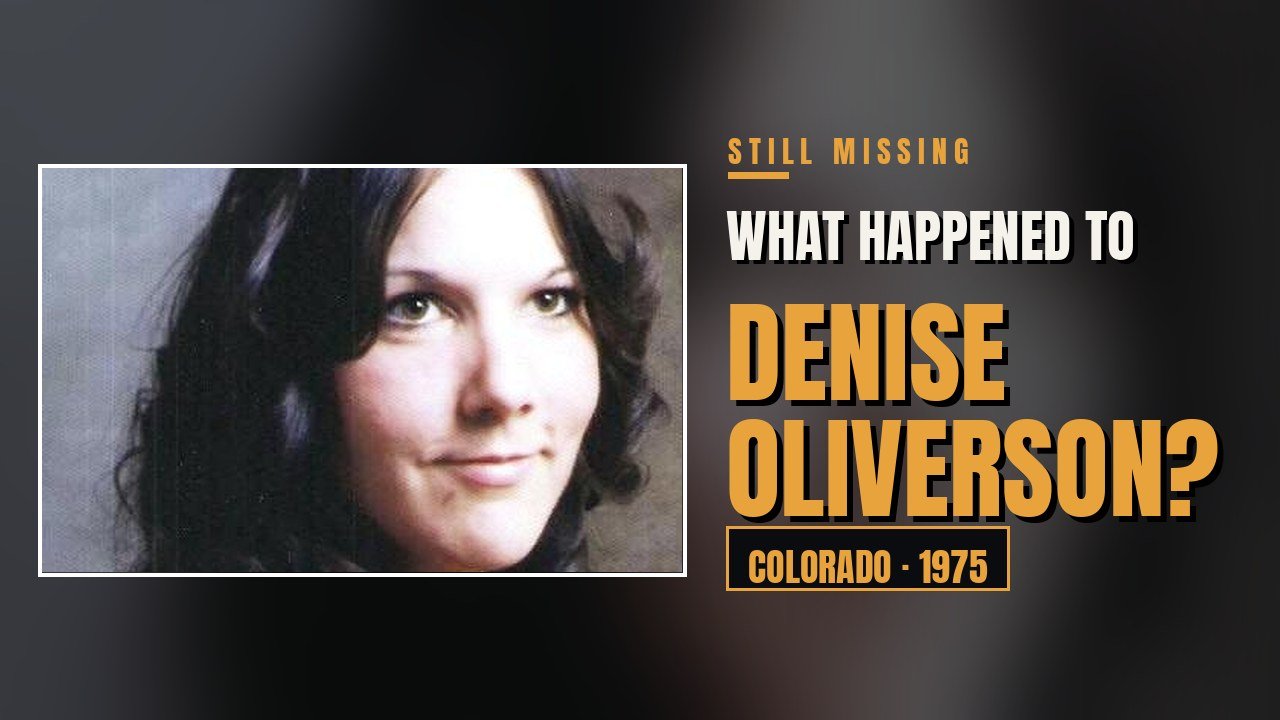
Key facts
- Name: Denise Lynn Oliverson
- Age at disappearance: 24
- Last seen: April 6, 1975 — leaving her home at 1619 LaVeta Street, Grand Junction, Colorado, on her bicycle to visit her parents
- Location: Grand Junction, Colorado
- Height / build: Not publicly detailed in surviving records
- Status: Still missing — 51 years; no body, no suspects, no arrests
- Case numbers: Not publicly confirmed
- Investigating agency: Grand Junction Police Department (Grand Junction’s cold case file #4)
The bike under the bridge
On April 6, 1975, Denise Lynn Oliverson jumped on her bike and left her home at 1619 LaVeta Street in Grand Junction, Colorado. She was going to visit her parents.
The next day, a search party and railroad employees found her bike — and her shoes — under the 5th Street bridge.
Denise was 24. She was never seen alive again.
That is, nearly in full, the known public record of what happened. A young woman sets out on a bicycle on a spring afternoon. The bike is found under a bridge, with her shoes. She is not. Fifty-one years have passed, and no one has ever been able to add a second paragraph to the story — no witnesses who saw her taken, no vehicle described, no suspect named, no body recovered.
Grand Junction’s police files carry her as cold case file #4. The local station KOUL — koo l1079’s cold-case series — has kept her name in circulation, and amateur researchers have kept asking the questions that were never answered: Who was Denise Oliverson? Who was waiting, or following, or offering a ride, on that road between LaVeta Street and her parents’ home?
The Bundy shadow
In 1989, fourteen years after Denise vanished, Ted Bundy — on death row in Florida, days from the electric chair — made a claim that attached itself to her case permanently.
Bundy told investigators he had killed a girl in Grand Junction in April 1975 and dumped her body in a river outside of town. The timeline fit. Bundy had been in the region. The month matched. A girl, April 1975, Grand Junction — it had to be Denise Oliverson. The claim became the best-known theory in her case, and it persists in every retelling.
But it was never proven. Bundy confessed to things he didn’t do and withheld things he did; he used confessions as currency in his final days, trading them for time. No body was ever recovered from any river outside Grand Junction matching his description. No corroborating evidence has ever tied him to Denise. The police have never closed her case on the strength of a dead man’s word.
So the Bundy theory sits where it has sat for thirty-seven years: plausible on the calendar, unproven everywhere else.
Gray-zone disclosure: in 2019, a kool1079 retrospective (“Grand Junction Murder Mystery Solved: Ted Bundy Did It”) went further, presenting the case as closed as a homicide on the strength of Bundy’s confession. That closure is not reflected in the authoritative missing-persons record: the Charley Project and NamUs still carry Denise Oliverson as an open missing-person case, and the majority of sources continue to treat it as unsolved. This article follows the majority record and keeps the case open, while noting the conflicting 2019 claim.
Theories: what might have happened
Ted Bundy killed her. The only named-suspect theory the case has. What supports it: Bundy’s own claim, the April 1975 date, his presence in the region, the river consistent with a body that was never found. What undermines it: Bundy’s confessions were unreliable currency, no remains were ever recovered, and investigators have never confirmed it. It is a theory, not a finding.
She was abducted by an opportunistic stranger. The shoes left with the bike under the bridge suggest a struggle or a forced removal, not a woman who rode away. A young woman cycling alone on a 1975 afternoon, in an era before anyone thought twice about it. What supports it: the abandoned bike and shoes, the absence of any other explanation. What is unproven: everything about who.
An accident. Considered only because it must be. What undermines it: accidents leave bodies, and Denise’s was never found — and the placement of the bike and shoes under a bridge reads like human intervention, not a fall.
Have information?
Contact the Grand Junction Police Department or the National Center for Missing & Exploited Children at 1-800-843-5678. In an emergency, dial 911.
Timeline
- Circa 1951 — Denise Lynn Oliverson is born.
- April 6, 1975 — Denise, 24, leaves her home at 1619 LaVeta Street in Grand Junction, Colorado, on her bicycle to visit her parents. She is never seen alive again.
- April 7, 1975 — A search party and railroad employees find her bike and her shoes under the 5th Street bridge.
- 1989 — On death row, Ted Bundy claims he killed a girl in Grand Junction in April 1975 and dumped her body in a river outside town. The claim is never proven.
- 1975–2026 — The case remains open as a Grand Junction cold case (cold case file #4). No suspects named. No arrests. No remains recovered.
- Today — Still missing, 51 years on.
FAQ
Is Denise Oliverson still missing?
Yes. As of October 2026, Denise Oliverson has been missing for 51 years. She was last seen on April 6, 1975, in Grand Junction, Colorado.
Was Denise Oliverson ever found?
No. Her bicycle and her shoes were found under the 5th Street bridge the day after she disappeared. Denise herself has never been located.
Did Ted Bundy kill Denise Oliverson?
In 1989, Ted Bundy claimed he killed a girl in Grand Junction in April 1975 and dumped her body in a river outside town — a timeline consistent with Denise’s disappearance. The claim was never proven, no remains were recovered, and the case remains unsolved.
How old would Denise Oliverson be today?
Denise was 24 in 1975 — she would be about 75 years old.
How can I help?
Share this case file. Anyone with information can contact the Grand Junction Police Department or NCMEC at 1-800-843-5678.
Sources
- Official / law enforcement: Grand Junction Police Department.
- News: kool1079.com, “Grand Junction Cold Case File #4: Denise Lynn Oliverson.”
- Reference: The Charley Project, “Denise Lynn Oliverson” (charleyproject.org).
- Media: Cold-case coverage and independent research aggregators.
Corrections (October 2026 fact-check): Added a gray-zone disclosure noting the 2019 kool1079 claim that the case was closed on Bundy’s confession, versus the Charley Project/NamUs record, which still lists Denise Oliverson as missing. Found an error? Tell us via the About page and we will fix it promptly and note the change here. Last verified October 2026.