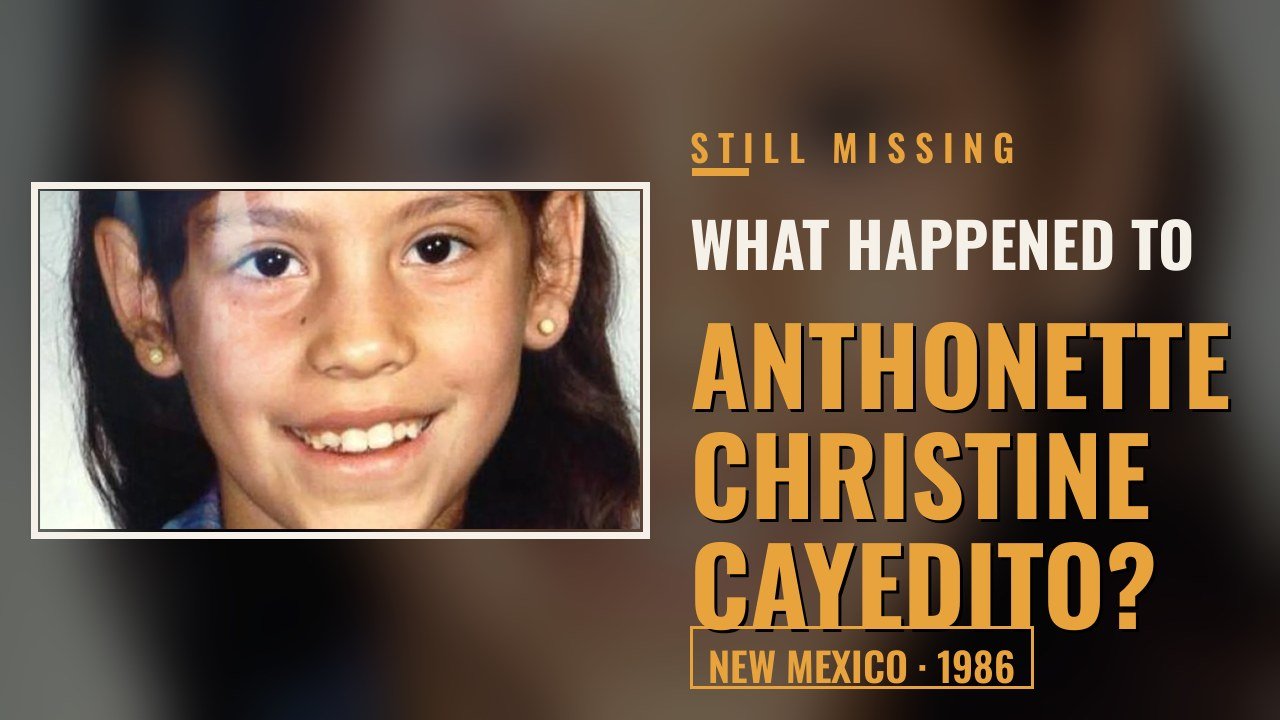
Key facts
- Name: Anthonette Christine Cayedito
- Born: December 25, 1976, Gallup, New Mexico
- Age at disappearance: 9
- Last seen: April 6, 1986, ~3:00 a.m.
- Location: 204 Arnold Circle #9, Gallup, New Mexico
- Height / build: 4’7″, ~70 lbs, brown hair, brown eyes; wore glasses
- Status: Still missing — officially listed as a missing person; case open with the FBI
- Case numbers: NCIC M-260201367; listed with NamUs
- Investigating agency: Gallup Police Department / FBI
The knock at 3 a.m.
Five years after it happened, Wendy Montoya finally told detectives what she remembered.
She was four years old on the night of April 6, 1986, asleep in the family’s apartment at 204 Arnold Circle in Gallup, New Mexico. (Most accounts, including the Charley Project and Unsolved Mysteries, give Wendy’s age as four; a 2016 Albuquerque Journal interview described her as five.) There was a knock at the door. Her big sister Anthonette — nine years old, the one who cooked for them and ironed their clothes — got up to answer it. The man on the other side said he was “Uncle Joe.”
Wendy said she watched two men grab her sister. Kicking and screaming — “Let me go! Let me go!” — they forced Anthonette into a brown van. Wendy was too frightened to tell anyone. She didn’t speak of it for five years, afraid of upsetting her mother, afraid of not being believed.
Her mother, Theresa “Penny” Cayedito, had been out with friends at a local bar that night. She came home around midnight, sent the babysitter home, and last saw Anthonette around 3 a.m. When Penny woke at 7 to get the girls ready for Bible school, Anthonette was gone. None of her clothes or belongings were taken. There was no sign of forced entry, no sign of a struggle at the door.
Neighbors told police a brown van or truck had pulled up around 3 a.m.
A three-day search — state police, volunteers on four-wheelers and horseback, two search dogs — turned up nothing. Sergeant Bill Johnson told reporters: “If there were any clues, they were trampled. Everywhere you turn, somebody’s been there already.”
Who Anthonette was
Anthonette Christine Cayedito was born on Christmas Day, 1976, to Penny Cayedito of the Navajo Nation and Larry Estrada, a carpenter. Navajo and Italian descent. After her parents separated, she was raised in Gallup with her two younger half-sisters, Wendy and Sadie.
Everyone who knew her used the same words: level-headed. Wise beyond her years. By six she was cooking for her sisters and ironing their clothes for the week. Her father said, “She was 9 going on 15.” Her youngest sister called it a “caregiver’s heart.” She was a fourth-grader at Lincoln Elementary, an above-average student who won the Presidential Fitness Award, devoted to her weekly Bible studies. Her favorite color was purple. She loved Michael Jackson and Ronnie Milsap. Her nickname was “Squirrel.”
She wore glasses. She wore a silver chain with a small turquoise cross.
The phone call
One year later, on the afternoon of April 12, 1987, the Gallup Police Department’s phone rang.
A young girl was on the line. She said her name — Anthonette Cayedito — several times. She said she was in Albuquerque. Then an adult’s voice cut in, shouting: “Who said you could use the phone?!” The girl screamed. There were sounds of a scuffle. The line went dead.
Forty seconds. Automatically recorded on tape. Too short to trace.
Penny listened to that tape over and over. “It was her voice. I would know my baby’s voice anywhere,” she said — she knew it by the way the girl pronounced their surname, and by the sound of the screaming. She did not recognize the adult’s voice.
In January 1989, the call was broadcast on the radio for the first time. New leads came in. None of them held.
The sightings — and the confession
Between 1986 and 1991, the alleged sightings piled up. A girl in a pink dress on a roadside in San Antonio. A child’s voice screaming “help me, help me” from a brown truck at a Thriftway gas station. A girl in a pink dress and white shoes at an El Paso bus depot with two Hispanic men, a mark on her cheek like Anthonette’s. A frightened girl in torn jeans at an Interstate 70 truck stop in Missouri, recognized from missing-persons posters.
And then, in 1991, the one nobody could shake: a waitress in Carson City, Nevada, served an unkempt couple with a teenage girl who kept knocking her utensils to the floor — reaching for attention. Each time the waitress handed them back, the girl grabbed her hand and squeezed it hard. After they left, the waitress found a napkin under the girl’s plate. Two messages: “Help me.” “Call the police.”
None of it led anywhere.
What did lead somewhere — or should have — was Penny herself. Detectives had long believed she knew more than she said. A neighbor told police it “wasn’t unusual for Penny to have people visit all hours of the night.” Detective Amos Hinshaw said plainly: “My gut feeling is that some family members may not be telling us all they know.”
In 1994, Penny told the FBI a different version of that night than the one she’d given in 1986. This time there was a second knock, and she said she’d told Anthonette to answer it. She waited thirty minutes. The girl never came back.
Then Penny confessed. She asked the agents: “What if me and Emo did this, would we both go to prison?” “Emo” was Emiliano Gardella, a man who’d given flowers to Anthonette three times in the days before she vanished. Penny said she and Emo had planned the abduction together — that she’d told her daughter to open the door, and that it was better she didn’t know where they’d take her.
No charges were ever filed. Penny failed an FBI polygraph. Detective Marty Esquibel said in 2010: “I’m pretty confident Penny had knowledge of who took Anthonette based on her failing a polygraph test administered by the FBI.”
Penny Cayedito died on April 18, 1999, in Tucson, Arizona — liver cirrhosis and cardiac issues, age 46. The FBI had wanted to interview her on her deathbed. They arrived too late.
The investigation today
Anthonette’s case has never closed. It was featured on Unsolved Mysteries on December 16, 1992 — nine days before what would have been her sixteenth birthday — generating 120 calls by the following March. None panned out.
On April 6, 2021, the 35th anniversary, the FBI announced renewed search efforts. Special Agent in Charge Eric Brown Sr. said: “We are asking anyone who might have information about this case to come forward now and help us find Anthonette.”
Her sisters never stopped. Wendy Montoya told the Albuquerque Journal in 2016 that losing Anthonette “broke my whole family up. It was a very dark and dysfunctional time” — a spiral of addiction and gangs she didn’t climb out of until rehab around 2007. “I’m not going to accept that she’s dead. I need proof.” In June 2022, her other sister Sadie Acevedo told KOAT: “It’s hard not knowing the point of no closure. What happened? Where did she go?” — and spoke directly to the sister she hasn’t seen in 36 years: “She’s safe. She has a family that loves her.”
Law enforcement officials believe Anthonette is deceased. She is still officially listed as a missing person, and her case remains open.
Theories: what might have happened
Abduction arranged by her mother. This is where the evidence points hardest: Penny’s FBI confession, the failed polygraph, the “Emo” connection, Wendy’s account of two men and a brown van, neighbors’ reports of a brown van at 3 a.m. But a confession without corroboration never produced charges, and Penny took whatever else she knew to her grave in 1999. It is the leading theory and an unprovable one.
Human trafficking. Investigators have raised it; the out-of-state sightings — Texas, Missouri, Nevada — suggest a girl being moved. Every sighting is unconfirmed. The 1991 Carson City napkin is the most specific and the most unverifiable.
Stranger abduction at the door. Wendy’s account stands on its own as a witness statement — but it came five years later from a child who’d been four, and her sister Sadie says she’s not sure a second knock ever happened. The brown van corroborates something; it doesn’t corroborate what.
The phone call. If the 1987 caller was Anthonette, she was alive a year later, held somewhere near Albuquerque, and someone was angry she’d reached a phone. Penny was certain. Police could never trace it. It remains forty seconds of tape and a mother’s certainty.
Have information?
Contact the FBI at 1-800-CALL-FBI (1-800-225-5324) or tips.fbi.gov, or the Gallup Police Department. In an emergency, dial 911.
Timeline
- December 25, 1976 — Anthonette Christine Cayedito is born in Gallup, New Mexico.
- April 6, 1986, ~3:00 a.m. — Anthonette answers a knock at the door; she is taken. Penny discovers her missing at 7:00 a.m.
- April 6–9, 1986 — Three-day search by state police and volunteers; no trace found.
- April 1986 — Witnesses report possible sightings in San Antonio and El Paso, Texas.
- April 12, 1987 — A girl claiming to be Anthonette calls Gallup police from Albuquerque; an adult shouts, the girl screams, the call is cut off after 40 seconds.
- January 1989 — The 911 call is broadcast on radio; new leads, none conclusive.
- September 1989 — Anthonette’s disabled aunt Louisa Estrada disappears from Gallup; found alive in Ciudad Juárez, Mexico, a month later.
- 1991 — Carson City, Nevada, waitress reports a teenage girl’s “Help me / Call the police” napkin.
- 1991 — Wendy, now 10, tells detectives about the two men and the brown van.
- December 16, 1992 — Unsolved Mysteries airs her case; 120 calls follow.
- 1994 — Penny confesses FBI involvement in the abduction to the FBI; fails a polygraph. No charges filed.
- April 18, 1999 — Penny Cayedito dies in Tucson, Arizona, before the FBI can interview her again.
- April 6, 2021 — On the 35th anniversary, the FBI announces renewed search efforts.
- June 2022 — Sister Sadie Acevedo speaks to KOAT-TV: “It’s hard not knowing the point of no closure.”
- Today — Still missing.
FAQ
Is Anthonette Cayedito still missing?
Yes. As of October 2026, Anthonette Cayedito has been missing for more than 40 years. Although law enforcement officials believe she is deceased, she is still officially listed as a missing person and her case remains open with the FBI.
Was Anthonette Cayedito ever found?
No. No trace of Anthonette has ever been found. The FBI renewed its public appeal for information on the 35th anniversary of her disappearance in April 2021.
What was the 911 phone call in the Anthonette Cayedito case?
On April 12, 1987 — one year after she vanished — a young girl called the Gallup Police Department, said she was Anthonette Cayedito, and said she was in Albuquerque. An adult shouted “Who said you could use the phone?!”, the girl screamed, and the 40-second call was cut off before it could be traced. Her mother said the voice was Anthonette’s.
Did Anthonette Cayedito’s mother confess?
In 1994, Penny Cayedito told the FBI she had helped plan her daughter’s abduction with a man known as “Emo” (Emiliano Gardella), and that she had told Anthonette to answer the door. She also failed an FBI polygraph. No charges were ever filed, and Penny died in 1999.
How old would Anthonette Cayedito be today?
Anthonette was born December 25, 1976 — she would turn 50 in December 2026.
How can I help?
Share this case file. If you have any information, contact the FBI at 1-800-CALL-FBI or the Gallup Police Department. Anthonette’s sisters are still waiting.
Sources
- Official / law enforcement: FBI — renewed appeal, 35th anniversary (April 6, 2021, via KOAT/KOB); Gallup Police Department.
- News: Albuquerque Journal (Wendy Montoya interview, 2016); Gallup Herald (Det. Marty Esquibel interview, 2010); KOAT-TV (Sadie Acevedo interview, June 2022); The Independent (Nov 1989).
- Reference: Wikipedia, “Disappearance of Anthonette Cayedito” (retrieved Oct 2026).
- Media: Unsolved Mysteries (Dec 16, 1992).
Found an error? Tell us via the About page and we will fix it promptly and note the change here. Last verified October 2026. Verification notes: the NamUs case number was removed (could not be confirmed from published sources); Wendy’s age at the time is given as 4 in most accounts but 5 in a 2016 Albuquerque Journal interview — both are noted above.