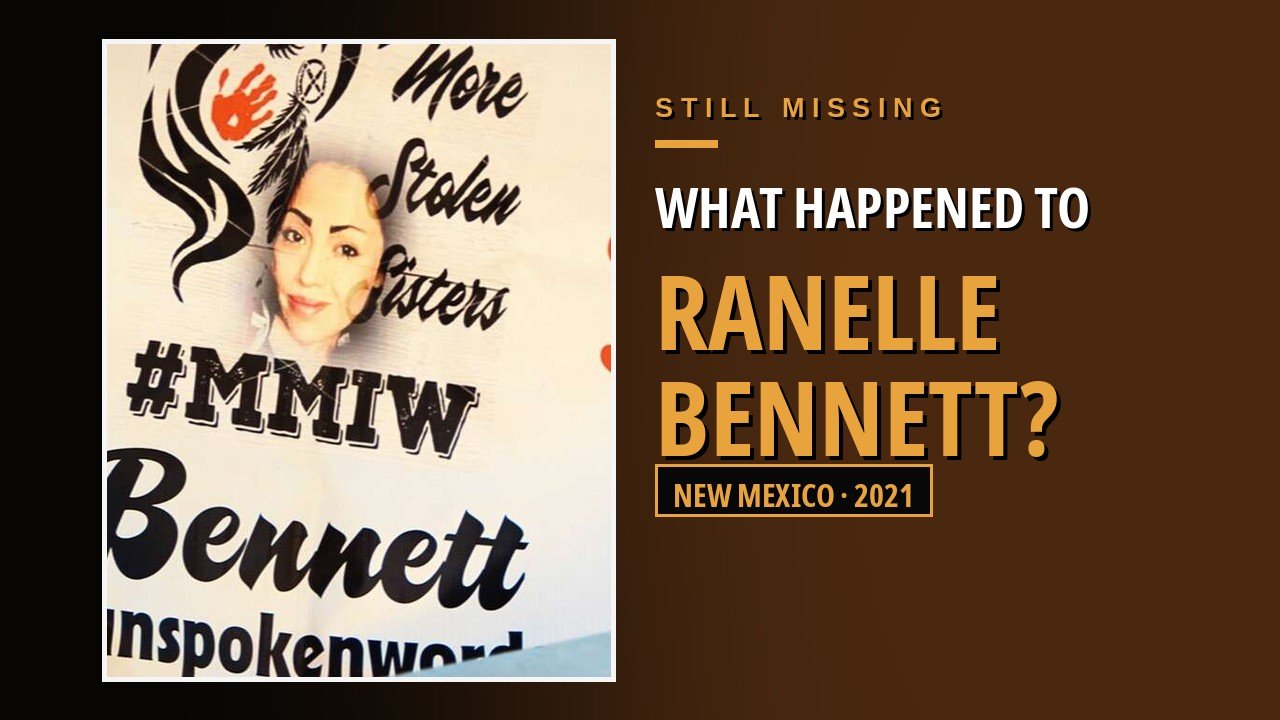
Key facts
- Name: Ranelle Rose Bennett
- Born: ~1988, Navajo Nation
- Age at disappearance: 33
- Last seen: June 15, 2021
- Location: Shiprock, New Mexico (Navajo Nation)
- Height / build: ~5’5″, medium build, long dark hair, brown eyes
- Status: Still missing — open case
- Investigating agency: Shiprock Police Department / Navajo Nation criminal investigators / BIA Missing and Murdered Unit
Three days before her daughter’s birthday
Ranelle Rose Bennett was last seen by her family on June 15, 2021, in Shiprock, New Mexico — three days before her daughter’s birthday.
She was 33, a mother of two, a Navajo woman living in the Four Corners. And then she was gone, and almost no one outside her family noticed. Her disappearance went unreported in the media for months.
Her mother, Rose Yazzie, filed a missing persons report on June 21, 2021. According to the family, she did not hear back from authorities for ten days. Yazzie found herself shuttling between the Shiprock Police Department and the Navajo Nation’s criminal investigator’s office, trying to get anyone to treat her daughter’s disappearance as urgent. Her other daughter, Georgianna Harrison, described the runaround. The family’s attorney, Darlene Gomez, said it plainly: the sole advocate making sure the case had the attention of the police department and the criminal investigator was Yazzie — the mother herself.
Five years later, Ranelle is still missing.
The documentary
In September 2026, New Mexico PBS aired Silence in the Sand, a documentary by Albuquerque filmmaker Chad Brummett about Ranelle’s case. Brummett made it as his capstone project for a master’s degree in journalism and media at the University of Alabama.
He’d set out to find a case like Gabby Petito’s — the 2021 disappearance that consumed national media for weeks — but with a different ending. Not a different outcome. A different level of attention.
“The initial thesis for the capstone was centered on the hypothesis exploring the theory of missing white woman syndrome,” Brummett said — the well-documented pattern in which missing white women receive vastly more media coverage than missing women of color. Ranelle vanished in the same summer the country was flooded with coverage of Petito. Ranelle’s case, Brummett said, stuck with him after he learned about her background as a mother of two.
The film doesn’t just tell one woman’s story. It asks why some disappearances become national emergencies and others barely register — and what that costs the families left to search alone.
Who Ranelle was
What the public record holds about Ranelle Rose Bennett is thin, and that thinness is part of the story. She was 33, Navajo, a mother of two children. Her family describes a woman whose absence is felt every day — in the birthdays she misses, in the annual walks they hold every June 15 in Shiprock to keep her name alive, in the social media accounts her mother and sisters maintain because no one else will do it for them.
The MMIW crisis — missing and murdered Indigenous women — is the context her case lives in. Thousands of Native women have vanished across the country; outdated databases, jurisdictional tangles between tribal, state, and federal agencies, and chronic under-resourcing mean cases like Ranelle’s start behind and stay there. Her mother waited ten days for a call back. That delay is not unusual. That is the scandal.
Theories: what might have happened
There is no public suspect, no public person of interest, and very little public evidence in Ranelle’s case — which is itself a finding about how the case was handled.
Foul play. Her family has never believed she left voluntarily. A mother of two, last seen by family, no word since — and a police response so slow her mother had to become her own investigator. The family’s attorney and the documentary both frame the case as one that never got the investigative urgency it deserved. What evidence exists has not been made public.
The jurisdictional gap. This isn’t a theory of what happened to Ranelle so much as a theory of why no one knows: a disappearance on the Navajo Nation, bounced between the Shiprock Police Department and tribal criminal investigators, with the BIA’s Missing and Murdered Unit now involved. Every handoff is a place where momentum dies.
What is known: as of October 2026, the case is open, and the family is still searching.
Have information?
Contact the BIA Missing and Murdered Unit: call 1-833-560-2065, text ‘BIAMMU’ and your tip to 847411, or email ojs_mmu@bia.gov. You can also contact the Shiprock Police Department. In an emergency, dial 911.
Timeline
- ~1988 — Ranelle Rose Bennett is born.
- June 15, 2021 — Last seen by family members in Shiprock, New Mexico, three days before her daughter’s birthday.
- June 21, 2021 — Her mother, Rose Yazzie, files a missing persons report; she hears nothing back for ten days.
- Summer 2021 — National media fixates on the Gabby Petito case; Ranelle’s disappearance goes unreported for months.
- 2022 — KOAT reports on the family’s search as the case approaches a year without answers.
- June 15, 2024 / 2025 — Family and friends hold annual awareness walks in Shiprock.
- September 2026 — Silence in the Sand, Chad Brummett’s documentary on Ranelle’s case and the MMIW crisis, airs on New Mexico PBS.
- Today — Still missing.
FAQ
Is Ranelle Rose Bennett still missing?
Yes. As of October 2026, Ranelle Rose Bennett has been missing for more than five years. Her family continues to hold annual awareness walks every June 15 in Shiprock.
What is “Silence in the Sand”?
A documentary by filmmaker Chad Brummett about Ranelle’s disappearance, made as his master’s capstone at the University of Alabama. It aired on New Mexico PBS in September 2026 and examines her case through the lens of “missing white woman syndrome” — the disparity in media coverage between missing white women and missing women of color.
Why did it take so long for Ranelle’s case to get attention?
Her mother filed the missing persons report on June 21, 2021, and said she heard nothing back from authorities for ten days, shuttling between the Shiprock Police Department and tribal investigators. Advocates point to the broader MMIW crisis: jurisdictional confusion, under-resourcing, and media indifference that leave Native families to investigate on their own.
How old would Ranelle Rose Bennett be today?
Ranelle was 33 when she vanished in June 2021 — she would be about 38 in 2026.
How can I help?
Share this case file. If you have any information, contact the BIA Missing and Murdered Unit at 1-833-560-2065, text ‘BIAMMU’ to 847411, or email ojs_mmu@bia.gov.
Sources
- Official / law enforcement: BIA Missing and Murdered Unit (tip line 1-833-560-2065).
- News: The Tri-City Record, “Documentary ‘Silence in the Sand’ sheds light on case of missing Shiprock women” (Sept 2026); KOAT, “Where is Ranelle Rose Bennett?” (2022).
- Media: Silence in the Sand, dir. Chad Brummett (New Mexico PBS, Sept 2026).
Found an error? Tell us via the About page and we will fix it promptly and note the change here. Last verified October 2026.