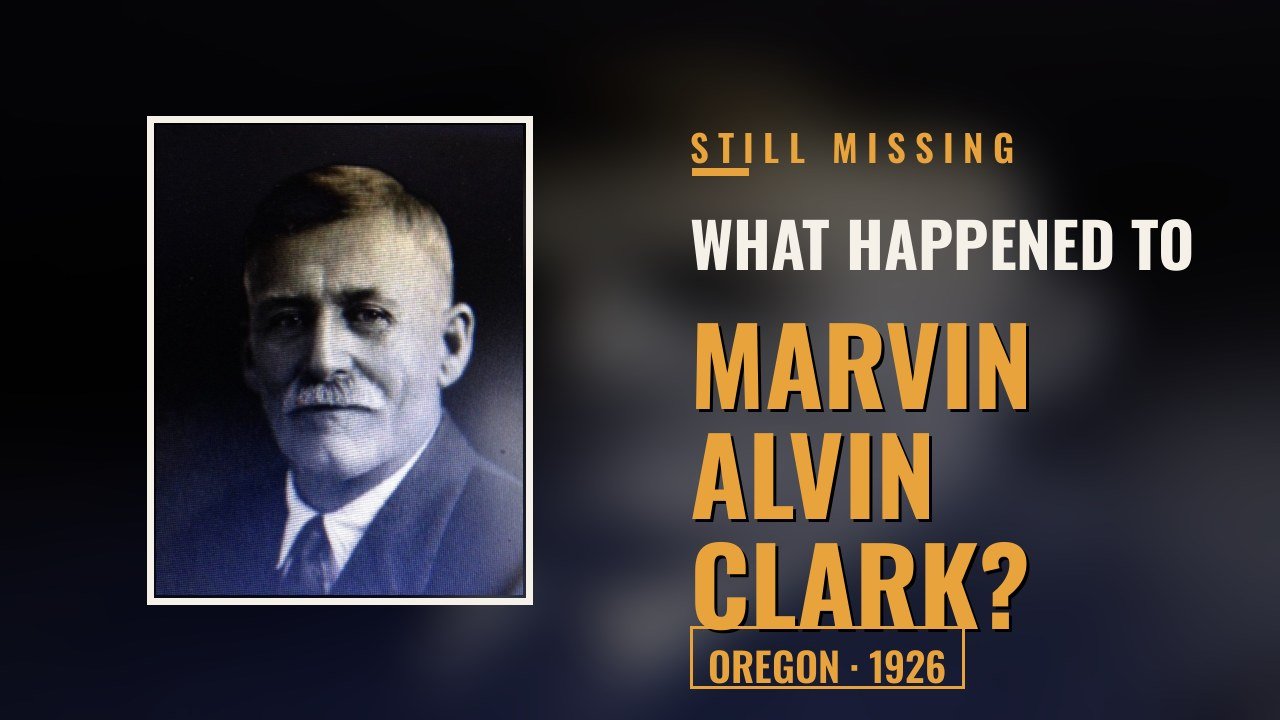
Key facts
- Name: Marvin Alvin Clark
- Born: c. 1852, Marion County, Iowa
- Age at disappearance: ~73–74
- Last seen: October 30, 1926, afternoon
- Location: En route from Tigard to Portland, Oregon
- Height / build: 5’8″; partially paralyzed on right side, halting gait; dark suit and slacks
- Status: Still missing — the oldest active missing-person case in the United States; NamUs-listed
- Investigating agency: (historical) Washington County / Portland authorities; NamUs
The Halloween weekend
On the afternoon of Saturday, October 30, 1926, 73-year-old Marvin Clark left his home in Tigard, Oregon, to visit his daughter in downtown Portland. It was Halloween weekend. He took a “motor stage” — the era’s bus — for the half-hour ride into the city.
His daughter, Sidney McDougall, managed and lived in the Hereford Hotel at 735 Hoyt Street in northwest Portland. It was a surprise visit. She didn’t even know he was coming.
He never arrived. Nobody in the family had contact with him that day. It took two days for anyone to realize: his wife Mary called Sydney to ask when her father planned on returning — and learned he had never gotten there in the first place.
Marvin Clark has now been missing for 99 years — the oldest active missing-person case in the United States.
Who Marvin was
Marvin Alvin Clark was born around 1852 in Marion County, Iowa, to parents from New York. He moved to Oregon with his wife Mary as early as 1910. He was, at one time, the town marshal of Linnton — a district that would later be absorbed into Portland — and he knew the area above St. Helens Highway well. He’d lived in Tigard for about 15 years.
He was partially paralyzed on his right side and walked with a halting gait — details the newspapers emphasized, hoping they’d make him recognizable. His daughter put up a $100 reward — roughly $1,800 in today’s dollars.
The postcard from Bellingham
The case’s strangest artifact arrived on November 9, 1926: Mary received a postcard from Bellingham, Washington — apparently sent by her husband. Witnesses in Bellingham reported seeing Marvin there on November 2 and 3. Other witnesses claimed to have seen him at the bus terminal in downtown Portland on October 30, dressed in a dark suit and slacks.
Was it him? A man with a halting gait, 150 miles north of where he was supposed to be, sending a postcard home? The sightings were never confirmed, and the postcard’s authorship was never proven. But they are the only traces Marvin Clark ever left.
The skeleton in the woods
In 1986 — sixty years later — loggers discovered a nearly complete human skeleton in a wooded area between Portland and Tigard. The remains were estimated at 35 to 55 years old at death, but nearby lay personal items from the late 19th and early 20th centuries: a .38 revolver, a pocket watch, leather shoes. The skull had a bullet hole — suggesting suicide.
Detectives wondered: could this be Marvin Clark? The story drew national attention in 2011. In 2018, DNA testing gave the answer: the remains were not his.
Marvin Clark’s whereabouts remain unknown. The case file, improbably, is still active.
Theories: what might have happened
An accident on the road. A 73-year-old partially paralyzed man traveling alone in 1926 — a fall from the motor stage, a wrong turn on foot, exposure. The roads out of Tigard were dirt, unlit, and dangerous at night. Searchers retraced his route and found nothing, but 1926 searches were limited by the era’s technology.
He kept going — to Bellingham. The postcard and the Washington sightings, if genuine, suggest Marvin didn’t vanish on the road to Portland but continued north — deliberately or in confusion. Why Bellingham? No one knows. The trail ends there either way.
Foul play. A lone elderly traveler with a reward-worthy name was a target in any era. But no evidence of robbery or violence ever surfaced, and the Bellingham traces point away from a roadside crime between Tigard and Portland.
Suicide. The 1986 skeleton showed what a suicide in those woods looked like — but it wasn’t him. Nothing else supports it.
Have information?
This is a historical case still carried as active. Tips can be directed to NamUs at 1-855-626-7600 (namus.nij.ojp.gov) or to the Tigard Police Department / Portland Police Bureau. In an emergency, dial 911.
Timeline
- c. 1852 — Marvin Alvin Clark is born in Marion County, Iowa.
- By 1910 — Moves to Oregon with wife Mary; later serves as marshal of Linnton.
- October 30, 1926, afternoon — Leaves Tigard for a surprise visit to his daughter in Portland. Never arrives.
- November 1, 1926 — Family realizes he is missing.
- November 2–3, 1926 — Reported sightings in Bellingham, WA (unconfirmed).
- November 6, 1926 — The Oregonian reports the disappearance.
- November 9, 1926 — Mary receives a postcard from Bellingham, apparently from Marvin.
- 1926–1986 — Case remains open but cold; daughter’s $100 reward unclaimed.
- 1986 — Skeleton found between Portland and Tigard; 2011 headlines speculate it’s Clark.
- 2018 — DNA confirms the remains are not Clark’s.
- October 2026 — 100th anniversary approaches; still the oldest active U.S. missing-person case.
- Today — Still missing.
FAQ
Is Marvin Clark still missing?
Yes. Marvin Clark vanished on October 30, 1926, and has never been found. His is the oldest active missing-person case in the United States — missing for 99 years.
What happened to Marvin Clark?
Nobody knows. He left Tigard for Portland and never arrived. A postcard from Bellingham, Washington, and unconfirmed sightings there are the only traces. A 1986 skeleton once thought to be his was ruled out by DNA in 2018.
Who was Marvin Clark?
A former town marshal of Linnton, Oregon, who lived in Tigard with his wife Mary. He was ~73, partially paralyzed on his right side, and was traveling to make a surprise visit to his daughter Sidney, who managed the Hereford Hotel in Portland.
Was the skeleton found in 1986 Marvin Clark?
No. Although the remains were found between Portland and Tigard with period artifacts, DNA testing in 2018 confirmed they belonged to someone else.
How can I help?
Share this case file. Tips on historical cases can go to NamUs at 1-855-626-7600.
Sources
- Official / law enforcement: NamUs (Marvin Alvin Clark listing); Uncovered.com case file.
- News: The Oregonian (Nov 1926; 2011 skeleton coverage); HistoricFlix retrospective; TikTok/Criminally Obsessed (Oct 2025, 99th anniversary).
- Reference: Wikipedia, “Disappearance of Marvin Clark” (retrieved Oct 2026).
- Media: True Crime Garage, ep. 645 — “Missing: Marvin Clark” (2023); Missing Persons Mysteries podcast (2025); Detective Writer (Oct 2024).
Found an error? Tell us via the About page and we will fix it promptly and note the change here.
Verification corrections (October 2026):
– BEFORE: daughter’s name spelled “Sydney McDougal” (two places) → AFTER: “Sidney McDougall” (per Wikipedia and contemporary genealogy records).
– BEFORE: “$100 reward — roughly $1,600 today” → AFTER: “roughly $1,800 in today’s dollars” (inflation-adjusted, per Wikipedia).
– The 1986 skeleton’s bullet hole in the skull (state medical examiner Dr. Karen Gunson, ruled a suicide), the $100 reward, the November 6, 1926 Morning Oregonian report, and the Hereford Hotel address (735 Hoyt Street) were all confirmed.
– Slug and URL unchanged.
Last verified October 2026.