Key facts
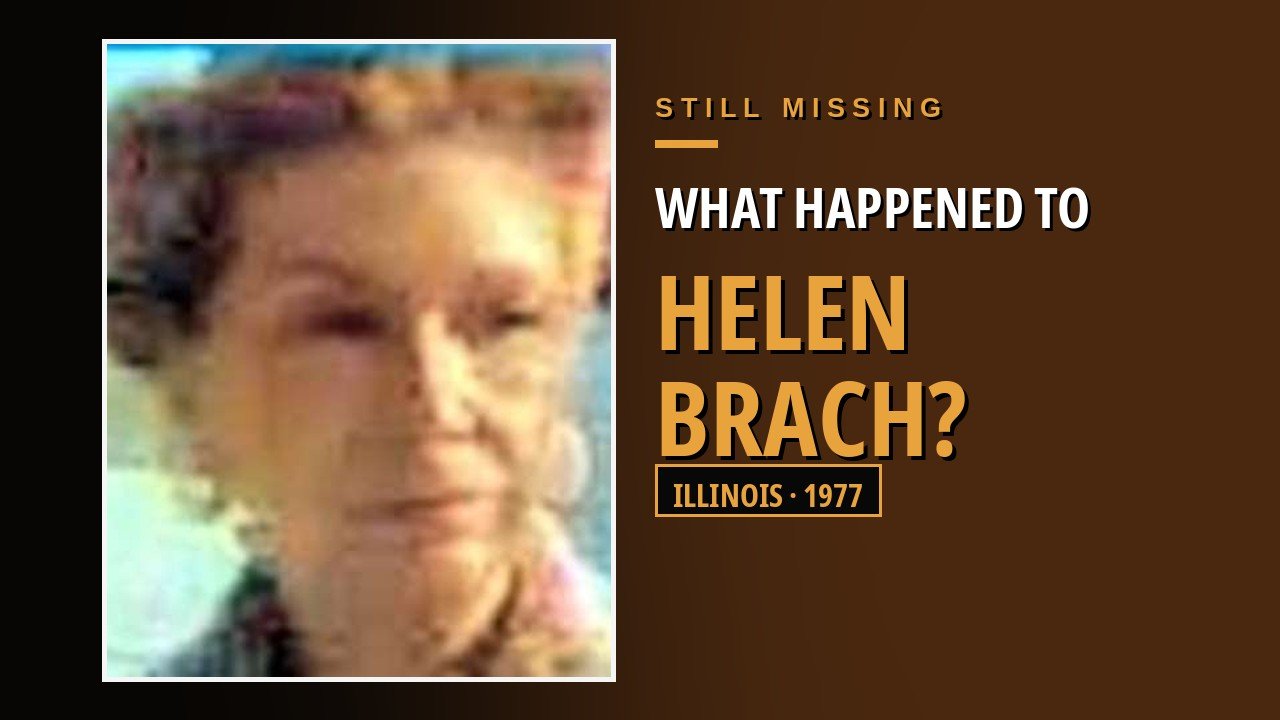
- Name: Helen Marie Brach (née Voorhees)
- Born: November 10, 1911, Unionport, Ohio
- Age at disappearance: 65
- Last seen: February 17, 1977
- Location: Last independent sighting near the Mayo Clinic, Rochester, Minnesota; home in Glenview, Illinois
- Height / build: About 5’6″, wealthy widow, distinctive presence
- Status: Declared legally dead in May 1984; body never found — still missing
- Investigating agency: FBI (federal investigation into associated criminal activity)
“I’m in a hurry, my houseman is waiting”
Those were among the last words anyone independent ever heard from Helen Brach.
On February 17, 1977, the 65-year-old widow — heiress to the E. J. Brach & Sons candy fortune, one of the richest women in America — had just finished a routine checkup at the Mayo Clinic in Rochester, Minnesota. She was healthy. A gift shop assistant near the clinic remembered her saying she was in a hurry, that her houseman was waiting. She was supposed to fly home to her mansion in Glenview, Illinois, just north of Chicago.
The crew of the commercial flight she was booked on never saw her board. But her houseman and chauffeur, Jack Matlick, told a different story: he said he collected her at O’Hare Airport, that she spent four days at home making no phone calls, and that he then drove her back to O’Hare for a flight to Florida.
Nobody ever confirmed any of it. Helen Brach simply stopped existing somewhere between Minnesota and Illinois — and in the nearly fifty years since, no trace of her has ever been found. She remains the wealthiest American woman ever to vanish without a trace.
Who Helen was
Helen Marie Voorhees was born November 10, 1911, on a small farm in Unionport, Ohio. She married her high school sweetheart at 17; they divorced by the time she was 21. Working at a country club in Palm Beach, Florida, she met Frank Brach — son of Emil J. Brach, heir to the candy company behind Brach’s candy corn and caramels. They married, built homes on Fisher Island, Florida, and in Glenview, Illinois, near the company’s Chicago factory.
Frank died in 1970. Helen, childless and immensely wealthy, poured money into animal welfare — endowing the Helen V. Brach Foundation in 1974 — and into horses. By 1973 she had entered Chicago’s equestrian world, a milieu of big money and, as federal investigators would discover, spectacular fraud.
That was where she met Richard Bailey: a handsome, sweet-talking horseman who targeted wealthy widows. His method was simple — buy horses for $5,000 to $10,000, resell them to marks for $50,000 to $100,000, and pocket the difference. Helen bought three horses in 1975 for $98,000 that later appraised at less than $20,000 combined.
Behind Bailey stood something darker: a network investigators called the “horse mafia,” tied to Chicago stable owner Silas Jayne, that killed valuable horses — by electrocution, poisoning, barn fires — to collect millions in fraudulent insurance payouts. Federal investigators eventually identified more than twenty co-conspirators across the Midwest.
By early 1977, Helen had discovered the fraud. And she was threatening to expose it.
The two men in the frame
Jack Matlick, the houseman, was the first focus of police attention. His story — the phantom days at home, the second trip to O’Hare — never quite held together. Investigators found eleven forged checks totaling more than $15,000 traced to him. A former federal agent who worked the case claimed after Matlick’s death that Matlick was indeed responsible for Helen’s disappearance. Matlick angrily denied it to reporters for the rest of his life. He died in a Pennsylvania nursing home on February 14, 2011 — three days short of the 34th anniversary of the day Helen vanished — at 79.
Richard Bailey was the second. The law enforcement theory: Bailey had Helen killed when she threatened to blow the whistle on his horse fraud, a threat that endangered dozens of criminals. More than a decade later, Bailey was charged with conspiring to murder her — but never convicted of it. In the mid-1990s, federal prosecutors built a racketeering case around decades of horse fraud, and the judge concluded Bailey was “so substantially involved in the murder of Helen Brach” that the maximum was justified: 30 years at age 65, for defrauding her. Bailey always maintained his innocence of the murder. He died in 2023.
Other accounts were stranger still: a 2005 informant’s claim that Helen was kidnapped, beaten, shot, and incinerated in a steel furnace near Gary, Indiana, on the orders of a Chicagoland horse dealer. Investigators have also long suspected Chicago Outfit involvement — the mob’s body-disposal expertise making a wealthy widow disappear “Jimmy Hoffa-style.” None of it was ever proven. No one was ever convicted of killing Helen Brach. Her body was never found.
In May 1984, she was declared legally dead, as of the date of her disappearance.
Theories: what might have happened
Murder to silence a whistleblower. The dominant theory: Helen discovered Bailey’s fraud, threatened exposure, and was killed by people with everything to lose — with the body destroyed so completely that nothing was ever found. Supporting it: the timing (she vanished just as she was threatening to talk), the scale of the criminal network, Bailey’s 30-year sentence reflecting the judge’s view of his involvement. Undercutting a definitive answer: no body, no convicted killer, and Bailey was never found guilty of the murder itself.
Murder by the houseman. Matlick’s inconsistent story, the forged checks, and the former federal agent’s posthumous accusation keep this theory alive. Against it: Matlick was never charged, and he denied it until death.
She’s alive / walked away. Effectively no one believes this. Helen was 65, wealthy, devoted to her animals and foundation, with no reason to abandon her life — and no trace of her has surfaced in 49 years.
Have information?
Contact the FBI at 1-800-CALL-FBI (1-800-225-5324) or submit a tip at tips.fbi.gov. You can also call the National Center for Missing & Exploited Children at 1-800-843-5678. In an emergency, dial 911.
Timeline
- November 10, 1911 — Helen Marie Voorhees is born in Unionport, Ohio.
- 1970 — Husband Frank Brach dies; Helen inherits the candy fortune.
- 1974 — Founds the Helen V. Brach Foundation for animal welfare.
- 1975 — Buys three horses for $98,000 through Richard Bailey’s circle (later appraised under $20,000).
- Early 1977 — Discovers the horse fraud; threatens to expose it.
- February 17, 1977 — Last independent sighting near the Mayo Clinic, Rochester, Minnesota.
- May 1984 — Declared legally dead.
- 1990s — Richard Bailey sentenced to 30 years for defrauding Brach; judge cites his involvement in her murder.
- February 14, 2011 — Jack Matlick dies in Pennsylvania at 79.
- 2023 — Richard Bailey dies.
- Today — Still missing. Her body has never been found.
FAQ
Is Helen Brach still missing?
Yes. Although she was declared legally dead in May 1984, her body has never been found and no one has ever been convicted of killing her. As of October 2026, the case remains unsolved after 49 years.
Was Helen Brach ever found?
No. Despite decades of investigation, informant claims, and searches, no trace of Helen Brach has ever been located.
How old would Helen Brach be today?
Helen was born November 10, 1911 — she would have turned 115 in November 2026. She was declared legally dead in 1984.
Who was Richard Bailey?
Richard Bailey was a Chicago-area horseman and con man who defrauded wealthy widows through marked-up horse sales. He was sentenced to 30 years in federal prison for defrauding Helen Brach; the sentencing judge said he was “so substantially involved in the murder of Helen Brach” that the maximum was warranted. He was never convicted of her murder and died in 2023.
What was the “horse mafia”?
Federal investigators used the term for a network around Chicago stable owner Silas Jayne that killed valuable horses — by electrocution, poisoning, and arson — to collect fraudulent insurance payouts, while figures like Bailey defrauded wealthy buyers. More than twenty co-conspirators were eventually identified.
How can I help?
Share this case file. Anyone with information should contact the FBI at 1-800-CALL-FBI.
Sources
- Official / law enforcement: Federal Bureau of Investigation (federal investigation into the Brach-associated horse-fraud network).
- News: Chicago Tribune (I-Team coverage of Richard Bailey); US Ghost Adventures, “The Disappearance of Candy Heiress, Helen Brach” (updated Nov 2025).
- Reference: Wikipedia, “Helen Brach” (retrieved Oct 2026); HistoryWiki (River Park), “Bailey, Richard.”
- Media: American Justice — “Who Killed the Candy Heiress? The Helen Brach Story” (1999); Who Killed the Candy Lady? by James Ylisela (Agate).
Found an error? Tell us via the About page and we will fix it promptly and note the change here. Last verified October 2026.